
Traditional & Specialised Waterproofing in Mumbai
Time-proven Indian terrace systems and high-performance specialist linings, from brick bat coba to polyurea. Atlanta Waterproofing & Protective System carries 15 systems in this category, selected by substrate, exposure and traffic rather than by habit. Each page below states when the system is right and when it is the wrong answer.
15 systems in this category
Brick Bat Coba Waterproofing
CoreBrick bat coba is the traditional Indian terrace system: broken brick pieces bedded in waterproofed cement mortar, laid to a fall and finished with china mosaic or IPS. It does three jobs at once — it creates the slope, it insulates the slab against Mumbai heat, and it forms a thick, forgiving water barrier.
IS 3067 · IS 2645
China Mosaic Waterproofing
CoreChina mosaic is a finish of broken glazed ceramic tile pieces set in waterproofed cement mortar over a terrace. Its white, reflective surface cuts heat gain into the slab, and its hard glazed face protects the waterproofing beneath from UV and foot traffic.
IS 3067
Polyurea Waterproofing
CorePolyurea is a spray-applied, fast-setting elastomeric coating that gels within seconds and forms a seamless, high-elongation, highly abrasion-resistant membrane. Because it has no joints and builds thickness in a single pass, it suits complex geometry and structures that must return to service quickly — tanks, podiums, parking decks and pools..
IS 3067
Base Coat Waterproofing
Base coat waterproofing is the bonded preparatory layer applied directly to the structural substrate before the main waterproofing system. It seals the surface, improves adhesion for what follows, and is the layer whose omission causes hollow, debonded coba and blistered membranes..
IS 2645
Shahabad Ladi Waterproofing
Shahabad ladi waterproofing lays natural Shahabad limestone slabs over a waterproofed and screeded terrace. The stone is dense, hard-wearing and traditional to western India, giving a durable walkable surface that protects the barrier beneath while handling heat and monsoon exposure well..
IS 3067
TRMX Waterproofing
TRMX is a named waterproofing system on our service list. We have not published a technical specification for it here, because we will not describe a branded product until its exact composition, manufacturer and datasheet are confirmed.
FRP Lining Waterproofing
FRP lining waterproofing bonds layers of glass-fibre reinforcement saturated with resin onto a prepared substrate, curing into a hard, seamless, chemically resistant shell. It is used where the lining must resist chemical attack and mechanical damage as well as water — tanks, bunds, channels and industrial containment..
IS 3067
Integral Waterproofing Compound (Admixture)
Integral waterproofing compound is an admixture dosed into the concrete or mortar mix itself, reducing permeability from within rather than coating the surface afterwards. It makes the concrete a better barrier, which is why it is specified alongside — never instead of — a membrane on water-retaining and below-grade structures..
IS 2645 · IS 456
Crystalline Waterproofing
Crystalline waterproofing uses reactive chemicals that penetrate concrete and grow insoluble crystals inside its capillary pores, blocking water paths within the concrete rather than on top of it. Because the reaction restarts whenever water returns, the system can re-seal fine hairline cracks that form later — a genuine self-healing property no coating offers..
IS 2645 · IS 3067
Box Type Waterproofing
Box type waterproofing wraps a below-grade structure in a fully continuous barrier — under the raft, up every retaining wall, and sealed at the top — so the structure sits inside an unbroken tank. It is the correct answer where groundwater exerts permanent hydrostatic pressure, because there is no joint or edge for water to find..
IS 3067 · IS 12200
Bentonite Waterproofing
Bentonite waterproofing uses panels or geotextile-encased sodium bentonite clay that swells on contact with water to form a dense, self-sealing gel against the structure. Its useful property is that it re-seals itself around minor punctures and settlement movement, which makes it forgiving in below-grade conditions where nothing can be inspected later..
IS 3067
Bituminous Felt Waterproofing
Bituminous felt waterproofing builds up alternating layers of hot bitumen and reinforcing felt into a multi-ply roof barrier. It is the traditional built-up roofing method that predates modern torch-on membranes, and it remains serviceable and economical for large, simple roof areas with straightforward detailing..
IS 1346 · IS 3067
Lime Terracing (Lime Concrete)
Lime terracing lays a lime-based concrete over a roof, traditionally beaten and cured over an extended period to form a dense, breathable, water-shedding layer. It matters on heritage buildings because it is vapour-permeable and chemically compatible with lime-mortar masonry, where a modern impermeable system would trap moisture and accelerate decay..
IS 3067
Mud Phuska Waterproofing
Mud phuska is a traditional roof treatment laying a graded layer of prepared mud over the slab, finished with flat brick tiles bedded in mortar. It serves as much for thermal insulation as for water shedding, which is why it persists on buildings where reducing heat gain into the top floor matters as much as keeping rain out..
IS 3067
Silane-Siloxane Water Repellent Treatment
Silane-siloxane treatment is a penetrating water repellent that lines the pores of masonry and concrete without filling them, so the surface sheds liquid water while still letting vapour escape. It is invisible when cured, which makes it the standard protective treatment for exposed brick, stone and fair-faced concrete where appearance must not change..
IS 3067
Traditional & Specialised Waterproofing on site
@atlantawaterproof ↗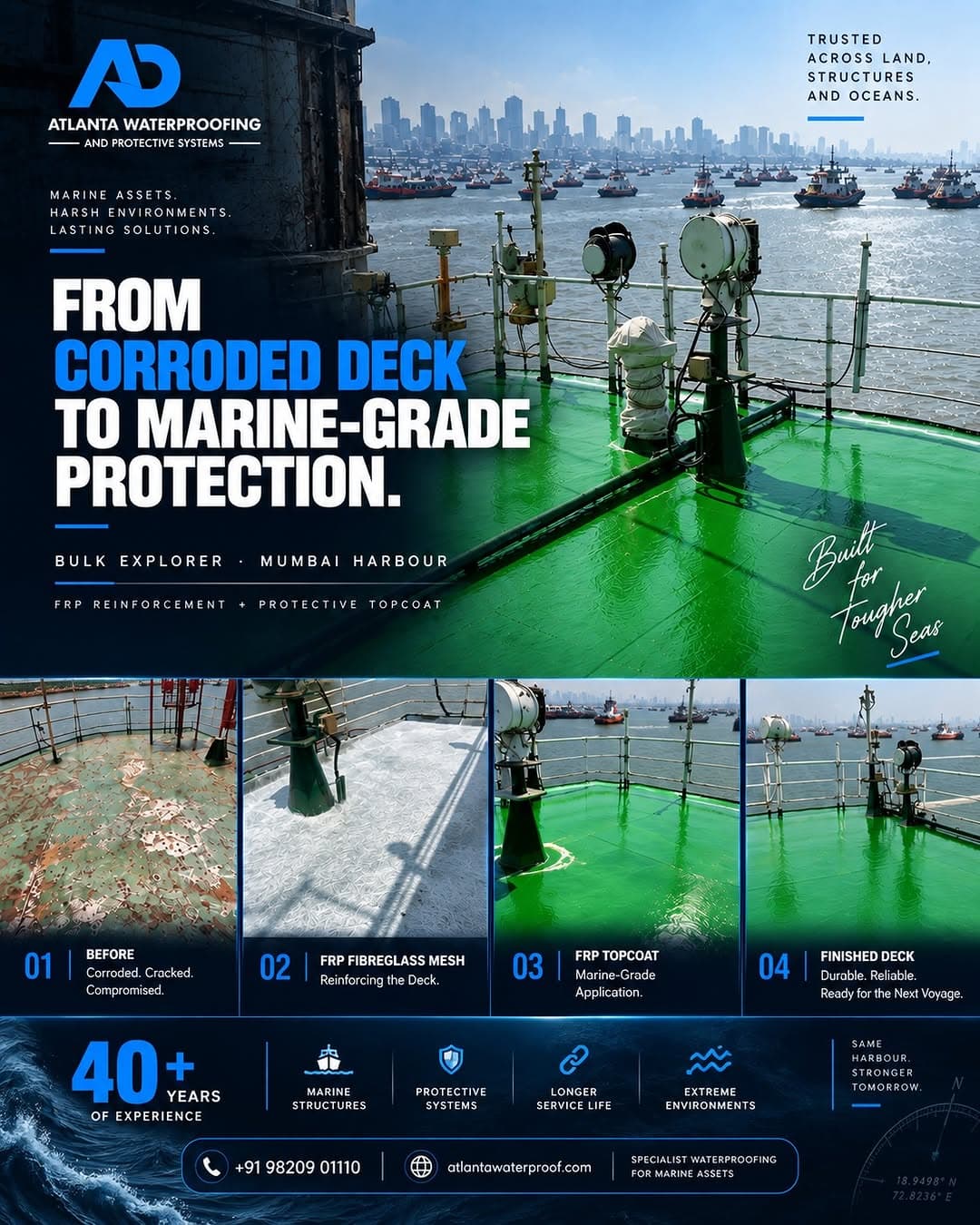
The rest of what we do
- SEC. 01 / COATINGSCoating & Protective Systems
Liquid-applied protective and decorative systems that form a continuous barrier over concrete, masonry and steel.
- SEC. 03 / MEMBRANEMembrane Waterproofing Systems
Sheet-applied barriers — torch-on bitumen, heat-welded thermoplastic and pre-applied HDPE for below-grade work.
- SEC. 04 / AREAArea-Specific Waterproofing
System selection driven by where the water is: terrace, basement, wet area, tank, podium, lift pit, pool.
- SEC. 05 / GROUTINGLeakage Treatment & Grouting
Remedial injection and joint treatment that stops water already moving through a structure.
- SEC. 06 / FINISHINGFlooring & Finishing
Wearing surfaces and screeds that protect the waterproofing layer beneath and take the traffic.
- SEC. 07 / RESTORATIONStructural & Restoration Works
Concrete repair, structural strengthening and facade renewal for ageing and distressed buildings.
Frequently asked
How do I choose between the systems in traditional & specialised waterproofing?
Selection is driven by the substrate, the exposure, the traffic the surface will take, and whether the structure moves. Each system page below states plainly when that system is the right choice and — more usefully — when it is not. If you are unsure, a site inspection settles it in one visit.
Can these systems be combined?
Frequently, yes. Most real buildings need more than one: a terrace system with grouting to stop an active crack first, or a facade coating over repaired plaster. What matters is that the systems are chemically and mechanically compatible with each other and with the substrate.
Do you supply materials, or only apply them?
We supply and apply as a single scope, so responsibility for both material selection and workmanship sits in one place. Where a project specification names a particular manufacturer or product, we work to that specification.
Book the inspection. It costs nothing and it settles the argument.
An engineer visits, finds the actual source, and tells you what the building needs and why. You get a clear scope before any money is discussed.
Mon–Fri 08:00–18:00 · Sat 09:00–16:00 · Jogeshwari West