
Leakage Treatment & Grouting in Mumbai
Remedial injection and joint treatment that stops water already moving through a structure. Atlanta Waterproofing & Protective System carries 5 systems in this category, selected by substrate, exposure and traffic rather than by habit. Each page below states when the system is right and when it is the wrong answer.
5 systems in this category
PU Grouting
CorePU grouting injects polyurethane resin under pressure into a leaking crack or joint. The resin reacts with the water it meets, expands into a closed-cell foam or flexible gel, and seals the leak path from within.
IS 3067
Injection Grouting
CoreInjection grouting forces a cementitious or epoxy grout under pressure into cracks, voids and honeycombed concrete to restore continuity and block water paths. Cementitious grouts fill larger voids economically; epoxy grouts bond structurally and are used where the repair must carry load across the crack..
IS 456 · IS 13935
Expansion Joint Treatment
Expansion joint treatment seals the deliberate gaps that let a structure move, using systems that accommodate that movement rather than resist it. Because the joint is designed to open and close, only a flexible sealing system with the right movement capability will survive — rigid filling of an expansion joint always fails..
IS 3067 · IS 12200
Tape Based Treatment
Tape-based treatment bonds a self-adhesive or reinforced waterproofing tape over a joint, crack or junction to bridge it. It is used for detail work — pipe junctions, wall-floor angles, sheet laps and localised repairs — where a strip of reinforced flexibility is what the detail actually needs..
IS 3067
Solvent Based Treatment
Solvent-based treatment applies a solvent-carried sealing product to penetrate porous substrates and seal fine leak paths. The low viscosity is the point — it wicks into capillaries a thicker coating cannot enter, then cures in place..
IS 3067
Leakage Treatment & Grouting — at a glance
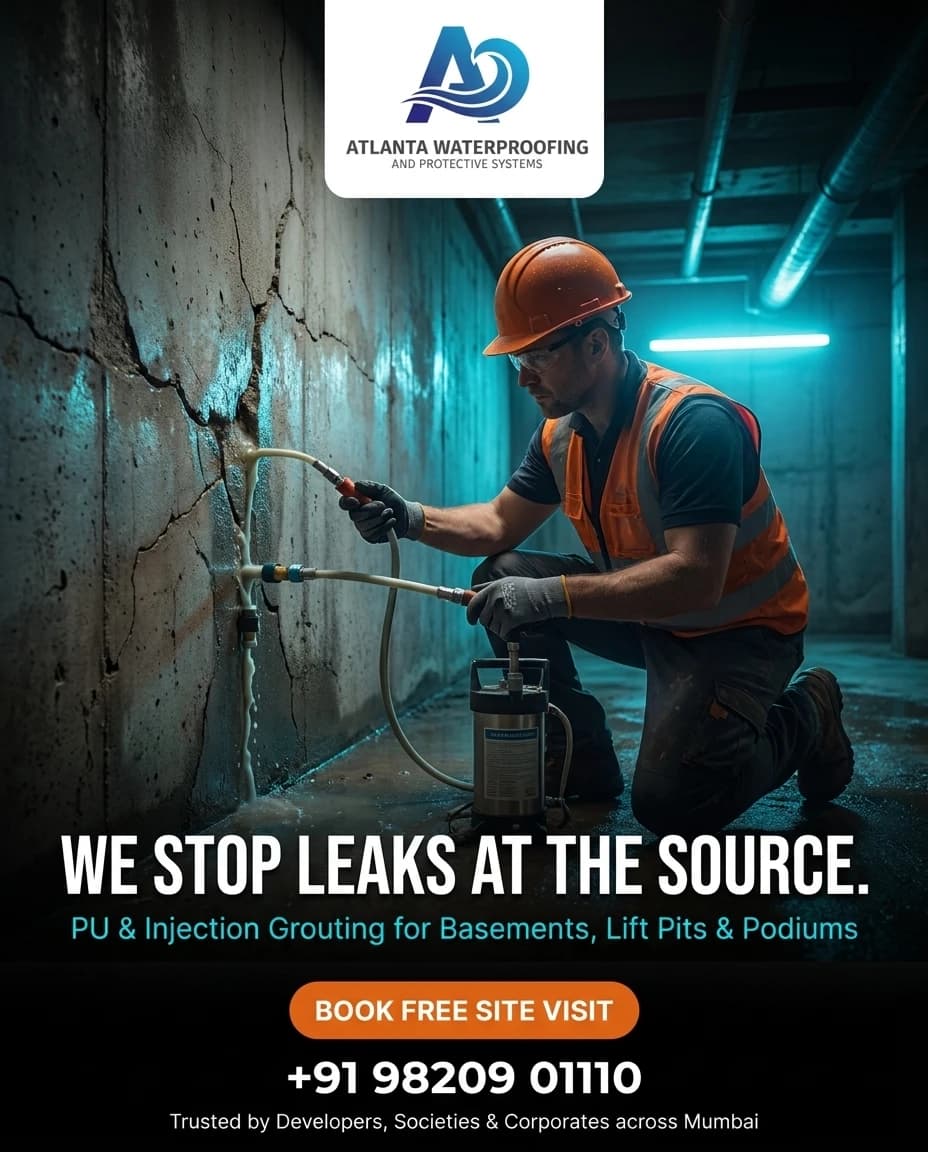
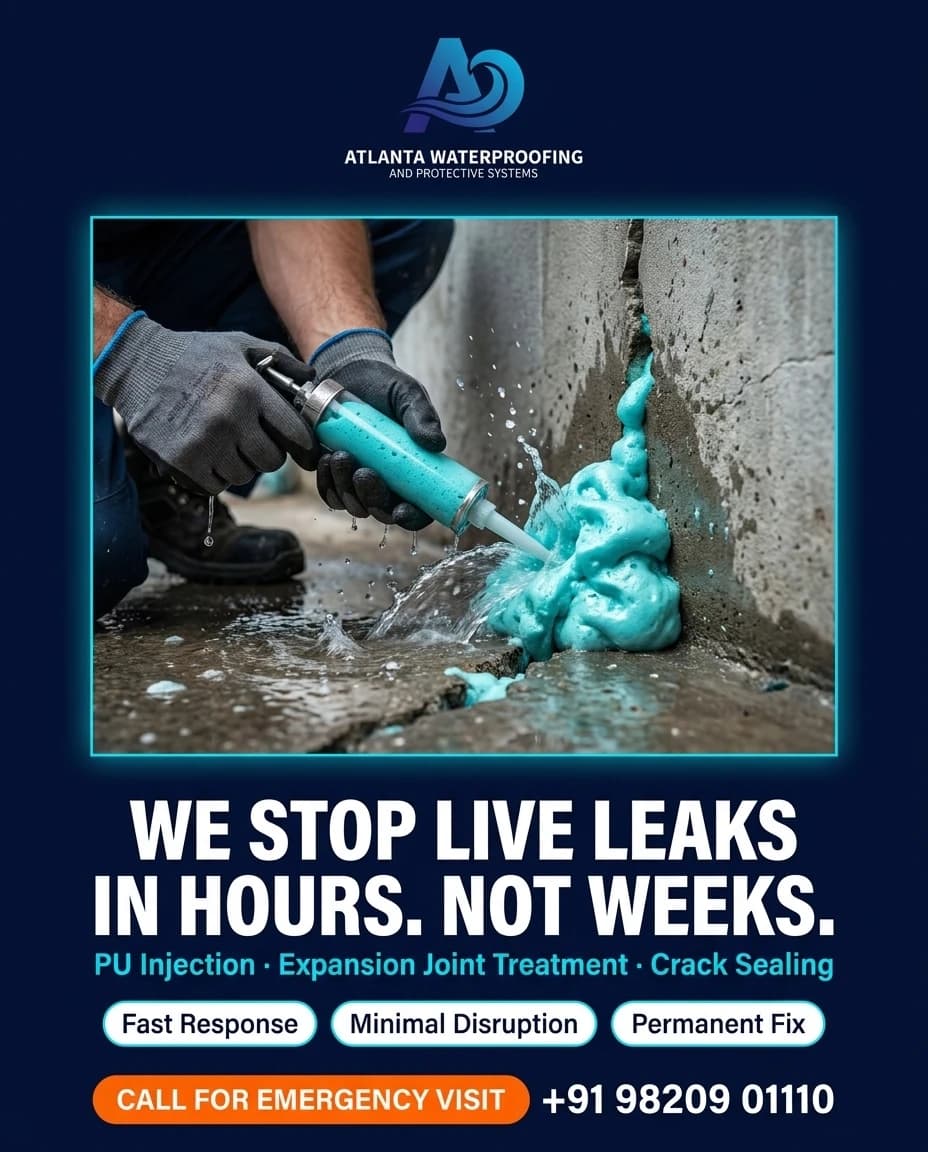
Tap a poster to WhatsApp us, or call +91 98209 01110.
Leakage Treatment & Grouting on site
@atlantawaterproof ↗
The rest of what we do
- SEC. 01 / COATINGSCoating & Protective Systems
Liquid-applied protective and decorative systems that form a continuous barrier over concrete, masonry and steel.
- SEC. 02 / TRADITIONALTraditional & Specialised Waterproofing
Time-proven Indian terrace systems and high-performance specialist linings, from brick bat coba to polyurea.
- SEC. 03 / MEMBRANEMembrane Waterproofing Systems
Sheet-applied barriers — torch-on bitumen, heat-welded thermoplastic and pre-applied HDPE for below-grade work.
- SEC. 04 / AREAArea-Specific Waterproofing
System selection driven by where the water is: terrace, basement, wet area, tank, podium, lift pit, pool.
- SEC. 06 / FINISHINGFlooring & Finishing
Wearing surfaces and screeds that protect the waterproofing layer beneath and take the traffic.
- SEC. 07 / RESTORATIONStructural & Restoration Works
Concrete repair, structural strengthening and facade renewal for ageing and distressed buildings.
Frequently asked
How do I choose between the systems in leakage treatment & grouting?
Selection is driven by the substrate, the exposure, the traffic the surface will take, and whether the structure moves. Each system page below states plainly when that system is the right choice and — more usefully — when it is not. If you are unsure, a site inspection settles it in one visit.
Can these systems be combined?
Frequently, yes. Most real buildings need more than one: a terrace system with grouting to stop an active crack first, or a facade coating over repaired plaster. What matters is that the systems are chemically and mechanically compatible with each other and with the substrate.
Do you supply materials, or only apply them?
We supply and apply as a single scope, so responsibility for both material selection and workmanship sits in one place. Where a project specification names a particular manufacturer or product, we work to that specification.
Book the inspection. It costs nothing and it settles the argument.
An engineer visits, finds the actual source, and tells you what the building needs and why. You get a clear scope before any money is discussed.
Mon–Fri 08:00–18:00 · Sat 09:00–16:00 · Jogeshwari West