
Injection Grouting in Mumbai
Injection grouting forces a cementitious or epoxy grout under pressure into cracks, voids and honeycombed concrete to restore continuity and block water paths. Cementitious grouts fill larger voids economically; epoxy grouts bond structurally and are used where the repair must carry load across the crack.
When this is the right system — and when it is not
Waterproofing is a selection problem before it is an application problem. Most failures we are called to fix were the wrong system for the substrate, not a bad product.
When this is the right choice
- Honeycombed or voided concrete
- Non-moving structural cracks needing load transfer (epoxy)
- Filling voids behind linings and around penetrations
When it is not
- The crack is actively leaking and moving — PU grouting is the correct tool
- The crack is live and will continue to move — a rigid epoxy will simply crack again alongside
The system, layer by layer
Every layer has a job. The ones people cut to save money are usually the ones holding the rest together.
- L01Survey and mapping
Extent of voids established.
- L02Port installation
Nipples set along the crack.
- L03Surface sealing
Crack face sealed so grout travels internally.
- L04Grout injection
Pumped sequentially under controlled pressure.
- L05Finishing
Ports removed, surface made good.
Almost every failure starts here
Preparation produces nothing visible, costs real money, and is the first thing removed from a cheap quotation. It is also what decides whether the system lasts.
The crack or void is surveyed and its extent established, by tapping and where necessary by drilling exploratory holes. The surface along the crack is cleaned so the surface seal will bond. Unlike polyurethane work, epoxy injection generally requires a dry or only slightly damp substrate, so the water source is dealt with first.
How we apply injection grouting
Step by step, with the specifications each stage is held to.
- 01
Establish whether the crack is live or dormant
This decides the material. A rigid epoxy injected into a crack that is still moving simply cracks again alongside the repair. Dormant cracks take epoxy for structural continuity; moving or leaking ones take flexible polyurethane.
- 02
Survey the void extent
Tapping and exploratory drilling establish how far honeycombing or voiding actually extends, so the grout volume can be estimated and later reconciled against what was injected.
- 03
Install ports along the crack
Injection nipples set at intervals along the crack line, spacing set against section thickness.
- 04
Seal the crack face
The visible crack line is sealed with rapid-set mortar between the ports, so grout is forced into the structure rather than escaping along the surface. Skipping this wastes grout and leaves the void unfilled.
- 05
Inject sequentially under controlled pressure
Ports injected in sequence, each until refusal or until grout shows at the adjacent port.
- 06
Log the volume against the estimate
Injected volume is recorded port by port and reconciled against the estimated void. A large shortfall means the void is not filled; a large excess means grout is escaping somewhere it should not.
- 07
Verify and finish
Fill verified by tapping or, where the specification requires, by core sampling. Ports removed and the surface made good.
What goes into the system
- Cementitious grout
- Non-shrink microfine cement grout for filling larger voids and honeycombing economically.
- Epoxy grout
- Low-viscosity structural epoxy where the repair must transfer load across a dormant crack.
- Surface seal
- Rapid-set mortar sealing the crack face so grout travels internally.
What goes wrong, and what we check
These are the failure modes we are called in to fix on other people's work. The checkpoints on the right are how we avoid repeating them.
Common failure modes
- Grout escaping through an unsealed crack face instead of penetrating
- Wrong grout selected for a live crack
- Insufficient pressure leaving voids unfilled
Our QC checkpoints
- Injection volume logged against estimated void
- Core sampling or tapping to verify fill
- Post-repair crack monitoring
Systems often specified alongside this one
- PU Grouting
PU grouting injects polyurethane resin under pressure into a leaking crack or joint.
- Column & Beam RCC Work
Column and beam RCC work is structural concrete repair to a building's primary frame — cutting out distressed concrete, treating or replacing corroded reinforcement, and rebuilding the section with polymer-modified repair mortar or micro-concrete.
- Building Restoration
Building restoration is the structural rehabilitation of an ageing or distressed building — diagnosing why the concrete is failing, repairing it properly, and protecting it so it does not fail again.
- Expansion Joint Treatment
Expansion joint treatment seals the deliberate gaps that let a structure move, using systems that accommodate that movement rather than resist it.
- Tape Based Treatment
Tape-based treatment bonds a self-adhesive or reinforced waterproofing tape over a joint, crack or junction to bridge it.
- Solvent Based Treatment
Solvent-based treatment applies a solvent-carried sealing product to penetrate porous substrates and seal fine leak paths.
Injection Grouting across Mumbai
The right specification changes with the locality — coastal chloride exposure, water table, and the age of the building stock all move the answer.
- Injection Grouting in Colaba
Ward A · 60 min from our office
- Injection Grouting in Girgaon
Ward C · 55 min from our office
- Injection Grouting in Worli
Ward G/South · 45 min from our office
- Injection Grouting in Bandra West
Ward H/West · 25 min from our office
- Injection Grouting in Chembur
Ward M/West · 40 min from our office
- Injection Grouting in Wadala
Ward F/North · 40 min from our office
- Injection Grouting in Fort
Ward A · 55 min from our office
- Injection Grouting in Churchgate
Ward A · 55 min from our office
- Injection Grouting in Marine Lines
Ward C · 55 min from our office
- Injection Grouting in Grant Road
Ward D · 50 min from our office
- Injection Grouting in Tardeo
Ward D · 50 min from our office
- Injection Grouting in Malabar Hill
Ward D · 55 min from our office

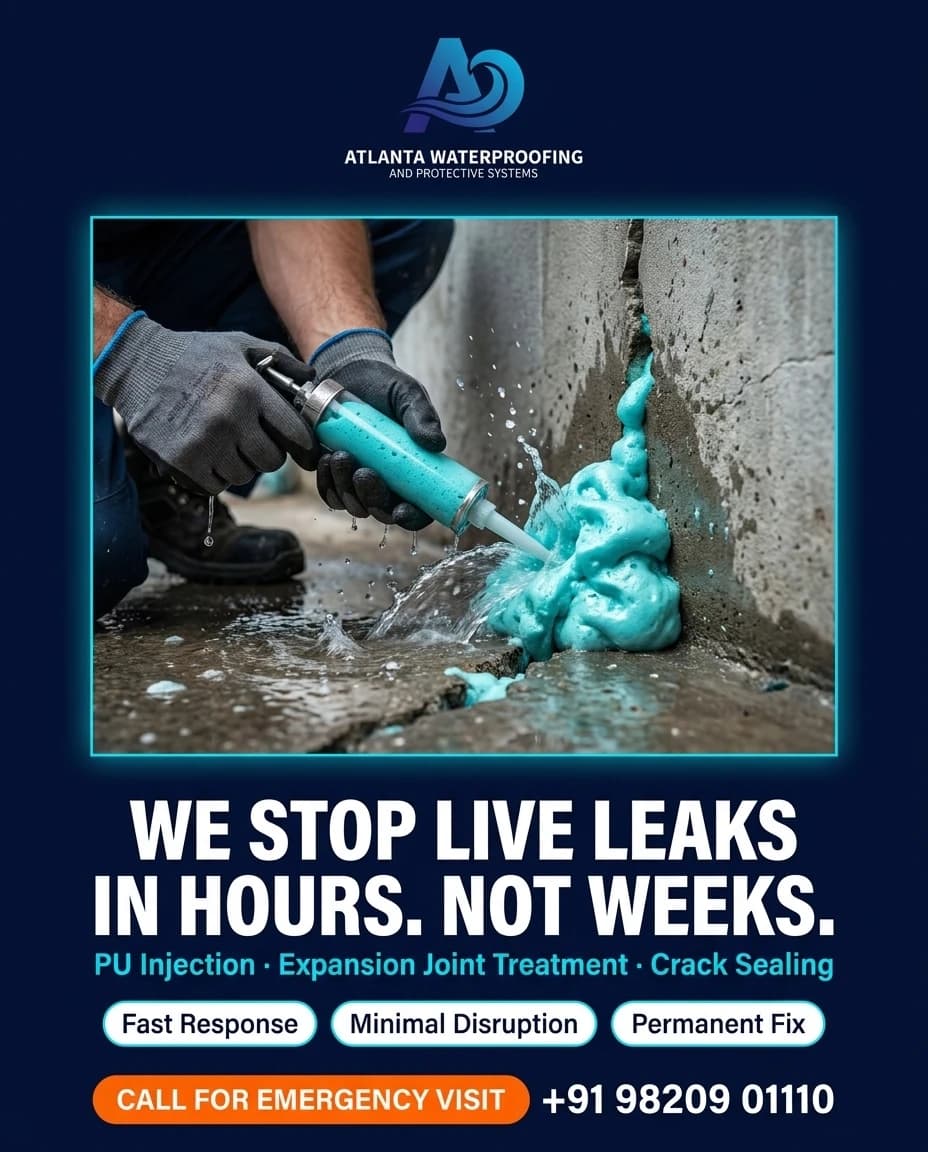
Injection Grouting and related work, from our Instagram
@atlantawaterproof ↗ Post
PostWater rarely respects boundaries
Injection Grouting — questions we get asked
When is injection grouting the wrong choice?
The crack is actively leaking and moving — PU grouting is the correct tool The crack is live and will continue to move — a rigid epoxy will simply crack again alongside Selecting a system that does not match the substrate, the exposure and the movement it will see is the most expensive mistake in waterproofing, because the failure only shows up after everything above it has been built.
Why does injection grouting fail when it is done badly?
In our experience the recurring causes are: grout escaping through an unsealed crack face instead of penetrating; wrong grout selected for a live crack; insufficient pressure leaving voids unfilled. None of these are material defects — they are execution defects, which is why the same product can last for years on one building and fail in a single monsoon on another.
How do I know the work was done properly?
Ask for evidence against these checkpoints: injection volume logged against estimated void; core sampling or tapping to verify fill; post-repair crack monitoring. A contractor who cannot produce them is asking you to take execution quality on trust, on work that will be buried under a finish and impossible to inspect afterwards.
How long does injection grouting last?
A permanent structural repair where the crack is dormant and the grout is correctly specified. We would rather set that expectation honestly than quote a headline number, because the substrate condition and the standard of application matter more to the outcome than the product's own datasheet figure.
What does injection grouting cost in Mumbai?
Cost depends on area, substrate condition, access, and how much preparation or structural repair is needed before the system can go on. We do not publish a rate per square foot, because a number quoted without seeing the building is either meaningless or misleading. The site inspection is free and produces an itemised scope you can compare against any other quotation.
Which standards apply to injection grouting?
The relevant Indian Standards for this work are IS 456, IS 13935. These cover the design, preparatory work and material requirements. Where a project specification names a different or additional standard, we work to the specification.
Book the inspection. It costs nothing and it settles the argument.
An engineer visits, finds the actual source, and tells you what the building needs and why. You get a clear scope before any money is discussed.
Mon–Fri 08:00–18:00 · Sat 09:00–16:00 · Jogeshwari West