
Warehouse Roof & Floor Waterproofing
Warehouse waterproofing is a large-area, low-detail problem: big roofs, long gutters, and floors that take constant wheeled traffic. The economics favour systems that cover ground quickly and can be maintained without emptying the building.
A warehouse owner, 3PL operator or facilities manager responsible for stored goods and the building that protects them.
What actually makes this difficult
The technical work overlaps with every other kind of building. The constraints are what differ, and they are what a contractor either understands or does not.
- Stock cannot get wet
- A roof leak is a stock-loss event long before it is a building problem.
- Very large areas
- Cost per square foot dominates, so system efficiency matters more than anywhere else.
- Continuous operation
- Racking cannot simply be moved. Work is phased around live aisles.
How we work on these projects
- Roof survey including gutters and downpipes, which cause more warehouse leaks than the roof sheet does.
- Phase bay by bay so racking stays loaded and aisles stay open.
- Reflective systems where roof heat gain affects stored goods.
- Floors specified for the actual wheel loading, not a generic traffic class.
Systems this kind of project usually needs
- TPO Membrane Waterproofing
TPO is a single-ply thermoplastic polyolefin membrane whose seams are hot-air welded rather than glued, producing a homogeneous joint as strong as the sheet. Its reflective white surface reduces roof heat gain, and it is UV-stable enough for permanent exposure, which makes it well suited to large exposed roofs and cool-roof strategies..
- APP Membrane Waterproofing
APP membrane is an atactic-polypropylene-modified bitumen sheet, torch-applied to a primed substrate with lapped and sealed joints. The APP modifier gives it a high softening point and good UV and heat resistance, which suits exposed Indian terraces.
- Polyurea Waterproofing
Polyurea is a spray-applied, fast-setting elastomeric coating that gels within seconds and forms a seamless, high-elongation, highly abrasion-resistant membrane. Because it has no joints and builds thickness in a single pass, it suits complex geometry and structures that must return to service quickly — tanks, podiums, parking decks and pools..
- IPS Screeding Work
IPS (Indian Patent Stone) screeding lays a cement-concrete topping, floated and finished to a hard, monolithic surface. On a terrace it creates the fall, protects the waterproofing beneath, and takes the traffic; internally it serves as a durable, economical floor..
- Chequered Tiles Work
Chequered tile work lays pressed cement tiles with a raised anti-skid pattern over a prepared bed, giving a hard, grippy wearing surface. On terraces and podiums the tiles are a protective and traffic layer over the waterproofing beneath, not a barrier in themselves..
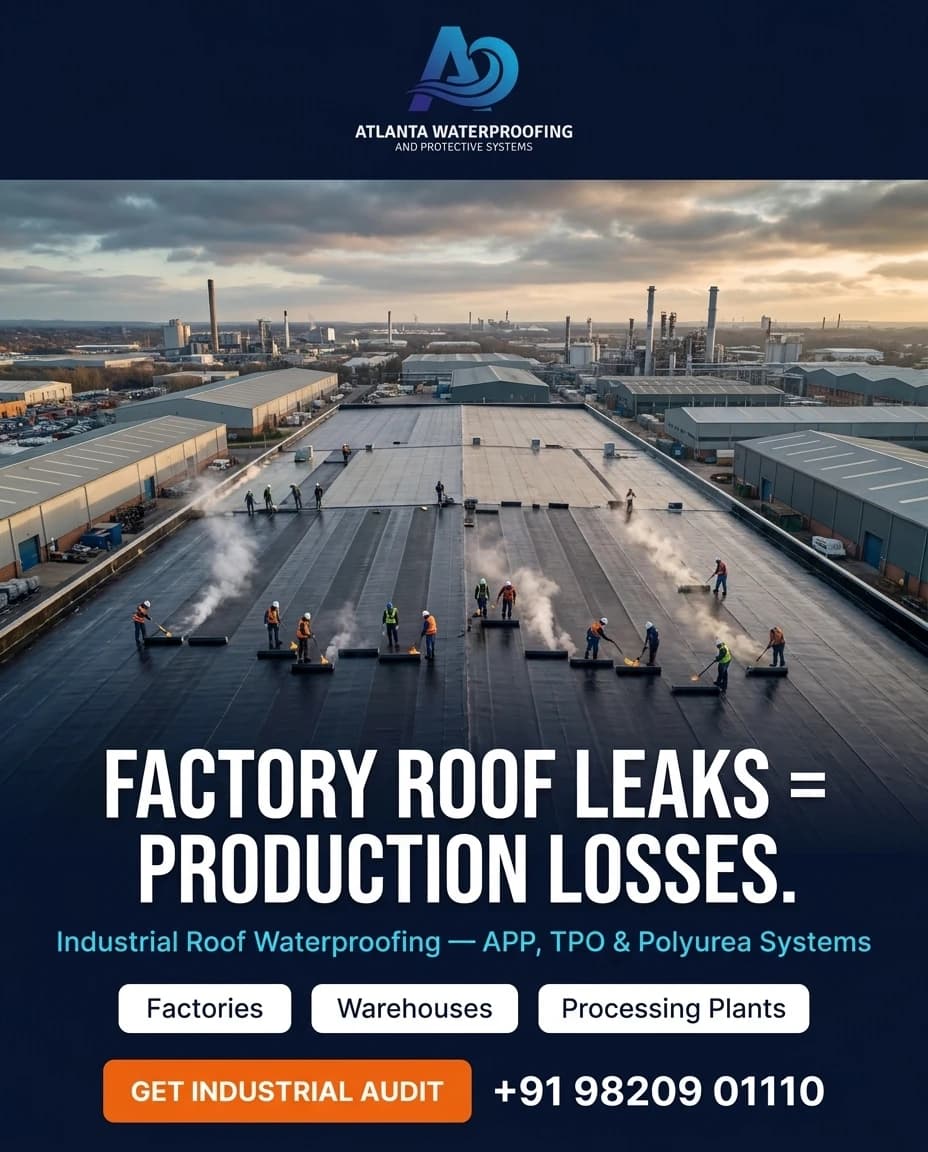
Warehouses — questions we get asked
Most of our leaks are at the gutters, not the roof. Is that normal?
Very. Gutters, valleys and downpipes are the most common warehouse leak source, especially when blocked or under-sized for Mumbai rainfall intensity. They should be surveyed before anyone proposes recoating the whole roof.
Can a metal roof be waterproofed without replacing it?
Usually yes. A liquid-applied or single-ply overlay can extend a sound metal roof's life considerably, provided corrosion is treated and fixings and laps are detailed first.
Will a reflective roof reduce internal temperature?
It reduces heat gain through the roof, which matters where goods are heat-sensitive or where the space is conditioned. It is not air conditioning, but the difference is measurable.
Can work proceed with the warehouse operating?
Yes, phased bay by bay. Roof work is generally carried out from above with the area beneath cordoned off.
Talk to us about your warehouse project
An engineer visits, identifies the actual source, and gives you a written scope you can act on. 40+ years of Mumbai buildings.
Mon–Fri 08:00–18:00 · Sat 09:00–16:00 · Jogeshwari West