
TPO Membrane Waterproofing in Mumbai
TPO is a single-ply thermoplastic polyolefin membrane whose seams are hot-air welded rather than glued, producing a homogeneous joint as strong as the sheet. Its reflective white surface reduces roof heat gain, and it is UV-stable enough for permanent exposure, which makes it well suited to large exposed roofs and cool-roof strategies.
When this is the right system — and when it is not
Waterproofing is a selection problem before it is an application problem. Most failures we are called to fix were the wrong system for the substrate, not a bad product.
When this is the right choice
- Large exposed roof areas, industrial and warehouse
- Cool-roof / heat-reflectance objectives
- Where a fully exposed, lightweight system is preferred
When it is not
- Small, heavily detailed areas where welding access is poor
- Where the roof will be buried under heavy traffic screed and reflectivity is wasted
The system, layer by layer
Every layer has a job. The ones people cut to save money are usually the ones holding the rest together.
- L01Deck
RCC or metal, prepared.
- L02Insulation (optional)
Where thermal performance is specified.
- L03TPO membrane1.2-1.8 mm
Mechanically fastened or adhered; seams hot-air welded.
- L04Perimeter terminations
Fastened and sealed.
Almost every failure starts here
Preparation produces nothing visible, costs real money, and is the first thing removed from a cheap quotation. It is also what decides whether the system lasts.
The deck is cleaned and made even, with protruding fixings removed and any corrosion on a metal deck treated. Where insulation is specified, it is laid and fixed to provide a continuous, level substrate. The surface must be dry before the membrane is laid, and free of oils or solvents that would compromise adhesion on adhered systems.
How we apply tpo membrane waterproofing
Step by step, with the specifications each stage is held to.
- 01
Prepare the deck
Cleaned and levelled, corrosion treated on metal decks, and insulation laid where specified.
- 02
Set out and secure
The membrane is either mechanically fastened along the laps to the pattern given by the wind-uplift calculation, or fully adhered, depending on the specification and exposure.
- 03
Trial-weld at every shift and temperature change
Test welds are made and peel-tested at the start of each shift and whenever ambient temperature changes materially. Hot-air welding is temperature and speed dependent, and a setting that worked in the morning can produce a cold weld by mid-afternoon.
- 04
Hot-air weld the seams
Seams are welded to produce a homogeneous joint as strong as the sheet itself, which is what distinguishes a welded thermoplastic system from an adhesive-bonded one.
- 05
Probe every seam
The full length of every weld is probed with a blunt tool once cool. Any opening is re-welded and re-probed.
- 06
Detail upstands and penetrations
Preformed corners and pipe boots are welded in at all upstands, outlets and penetrations rather than being cut and pieced together on site.
- 07
Terminate at the perimeter
Perimeter terminations are mechanically fixed and sealed, since wind uplift concentrates at edges and corners.
What goes into the system
- Membrane
- Thermoplastic polyolefin single-ply at 1.2–1.8 mm, reflective white for cool-roof performance and UV-stable for permanent exposure.
- Fasteners and plates
- To the wind-uplift fixing pattern for mechanically fastened systems.
- Preformed details
- Corners, pipe boots and outlet details from the same system as the sheet.
- Termination bars
- Mechanically fixed and sealed at all perimeter terminations.
What goes wrong, and what we check
These are the failure modes we are called in to fix on other people's work. The checkpoints on the right are how we avoid repeating them.
Common failure modes
- Cold welds from incorrect hot-air temperature or speed
- Fastener pull-through in high wind uplift
- Membrane damage from unprotected foot traffic
Our QC checkpoints
- Probe every weld seam
- Trial welds at the start of each shift and on temperature change
- Uplift/fastening pattern verified
Systems often specified alongside this one
- APP Membrane Waterproofing
APP membrane is an atactic-polypropylene-modified bitumen sheet, torch-applied to a primed substrate with lapped and sealed joints.
- Terrace Waterproofing
Terrace waterproofing is the application of a continuous water barrier across a roof slab, laid to a fall so rainwater drains rather than ponds.
- SBS Membrane Waterproofing
SBS membrane is a styrene-butadiene-styrene-modified bitumen sheet.
- HDPE Membrane Waterproofing
HDPE membrane waterproofing uses a high-density polyethylene sheet, generally pre-applied below rafts and against retaining walls before concrete is poured.
TPO Membrane Waterproofing across Mumbai
The right specification changes with the locality — coastal chloride exposure, water table, and the age of the building stock all move the answer.
- TPO Membrane Waterproofing in Churchgate
Ward A · 55 min from our office
- TPO Membrane Waterproofing in Marine Lines
Ward C · 55 min from our office
- TPO Membrane Waterproofing in Tardeo
Ward D · 50 min from our office
- TPO Membrane Waterproofing in Malabar Hill
Ward D · 55 min from our office
- TPO Membrane Waterproofing in Prabhadevi
Ward G/South · 45 min from our office
- TPO Membrane Waterproofing in Mahalaxmi
Ward D · 48 min from our office
- TPO Membrane Waterproofing in Bandra West
Ward H/West · 25 min from our office
- TPO Membrane Waterproofing in Khar
Ward H/West · 22 min from our office
- TPO Membrane Waterproofing in Santacruz
Ward H/West & H/East · 18 min from our office
- TPO Membrane Waterproofing in Andheri West
Ward K/West · 12 min from our office
- TPO Membrane Waterproofing in Andheri East
Ward K/East · 15 min from our office
- TPO Membrane Waterproofing in Goregaon
Ward P/South · 12 min from our office
TPO Membrane Waterproofing — at a glance
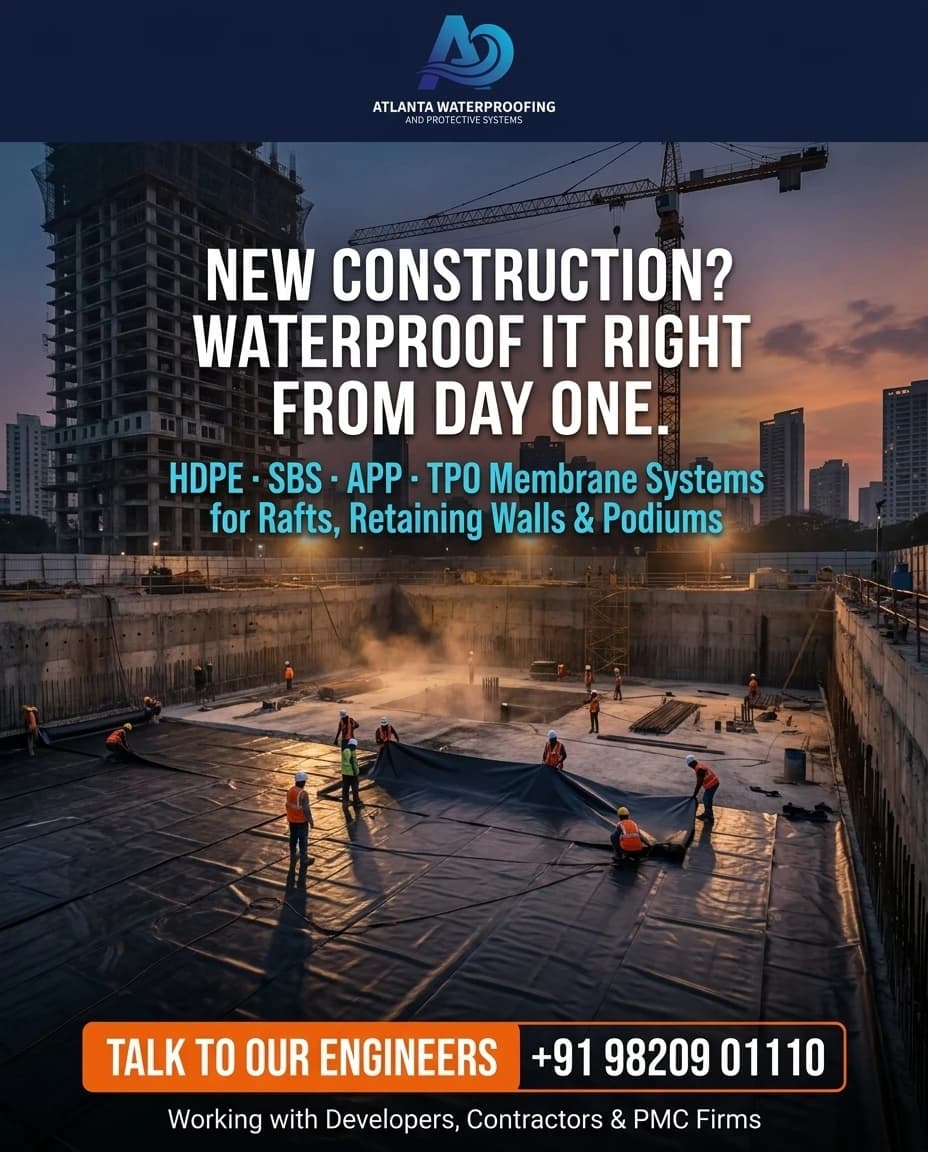
Tap a poster to WhatsApp us, or call +91 98209 01110.
TPO Membrane Waterproofing and related work, from our Instagram
@atlantawaterproof ↗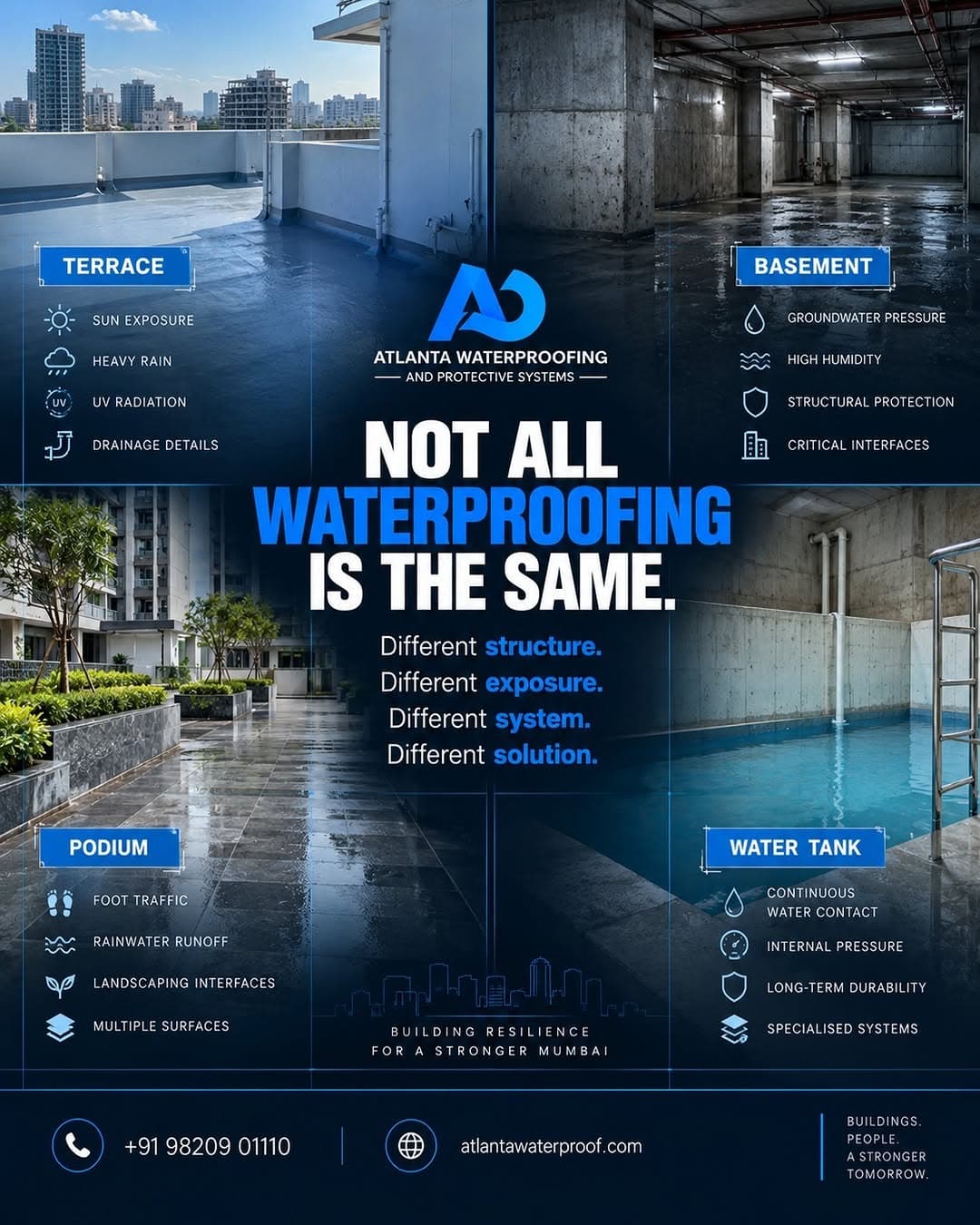
TPO Membrane Waterproofing — questions we get asked
When is tpo membrane waterproofing the wrong choice?
Small, heavily detailed areas where welding access is poor Where the roof will be buried under heavy traffic screed and reflectivity is wasted Selecting a system that does not match the substrate, the exposure and the movement it will see is the most expensive mistake in waterproofing, because the failure only shows up after everything above it has been built.
Why does tpo membrane waterproofing fail when it is done badly?
In our experience the recurring causes are: cold welds from incorrect hot-air temperature or speed; fastener pull-through in high wind uplift; membrane damage from unprotected foot traffic. None of these are material defects — they are execution defects, which is why the same product can last for years on one building and fail in a single monsoon on another.
How do I know the work was done properly?
Ask for evidence against these checkpoints: probe every weld seam; trial welds at the start of each shift and on temperature change; uplift/fastening pattern verified. A contractor who cannot produce them is asking you to take execution quality on trust, on work that will be buried under a finish and impossible to inspect afterwards.
How long does tpo membrane waterproofing last?
UV-stable for exposed service; weld quality is the dominant life factor. We would rather set that expectation honestly than quote a headline number, because the substrate condition and the standard of application matter more to the outcome than the product's own datasheet figure.
What does tpo membrane waterproofing cost in Mumbai?
Cost depends on area, substrate condition, access, and how much preparation or structural repair is needed before the system can go on. We do not publish a rate per square foot, because a number quoted without seeing the building is either meaningless or misleading. The site inspection is free and produces an itemised scope you can compare against any other quotation.
Which standards apply to tpo membrane waterproofing?
The relevant Indian Standards for this work are IS 3067. These cover the design, preparatory work and material requirements. Where a project specification names a different or additional standard, we work to the specification.
Book the inspection. It costs nothing and it settles the argument.
An engineer visits, finds the actual source, and tells you what the building needs and why. You get a clear scope before any money is discussed.
Mon–Fri 08:00–18:00 · Sat 09:00–16:00 · Jogeshwari West