
Waterproofing for Developers & Real Estate Projects
Developer waterproofing is programme work. The barrier has to match the drawing, go in at the right point in the sequence, and never become the reason handover slips. We work to specification on podiums, basements, terraces and wet areas, hold the pre-pour and pre-cover inspections, and produce the photographic and test records your PMC will ask for at handover.
A project manager, site engineer or procurement lead at a residential or commercial developer, appointing a waterproofing specialist against a drawing and a specification.
What actually makes this difficult
The technical work overlaps with every other kind of building. The constraints are what differ, and they are what a contractor either understands or does not.
- Sequence-critical
- Pre-applied below-grade systems and podium membranes have exactly one window. Miss it and the fix costs ten times as much.
- Specification compliance
- The system, thickness and lap detail have to match what the consultant specified, and be evidenced.
- Handover documentation
- Flood test records, pre-pour photographs and material certificates are needed for the completion file.
- Defect liability
- A leak in year two is your problem, not the buyer's. The detailing decides whether that happens.
How we work on these projects
- We read the drawings and the specification before quoting, and flag detailing gaps at tender rather than on site.
- Pre-pour and pre-cover hold points, photographed penetration by penetration.
- Flood testing before any protection or screed goes down.
- Coordination with the RCC and MEP contractors so penetrations are collared before they are buried.
- A complete handover file: test records, photographs, material datasheets and certificates.
Systems this kind of project usually needs
- Basement Waterproofing
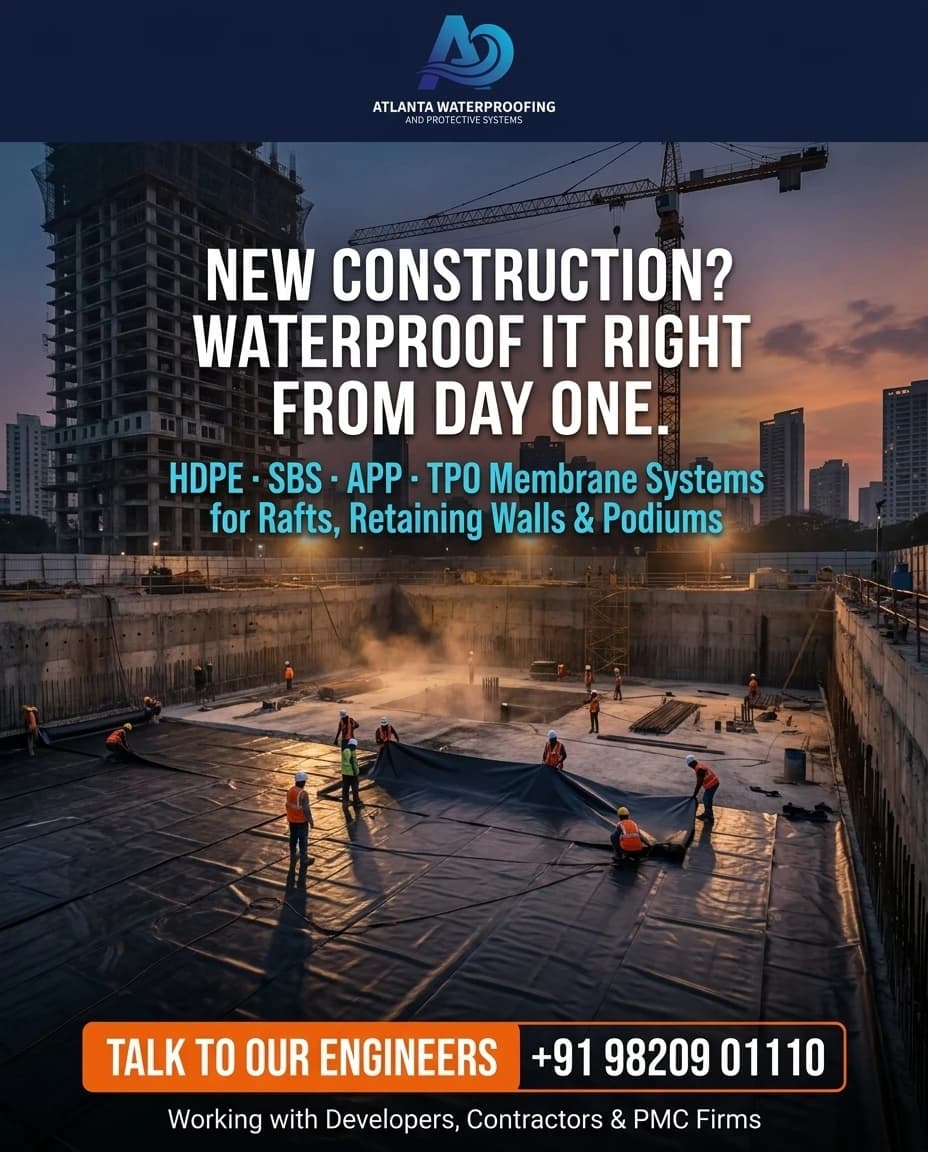
Basement waterproofing protects a below-grade structure against groundwater under hydrostatic pressure. Because the water pushes inward continuously, the reliable approach is a box-type system — a continuous barrier wrapping raft and retaining walls — applied pre-construction where possible.
- Podium Waterproofing
Podium waterproofing protects a landscaped or trafficked deck sitting above occupied space — typically parking, a clubhouse or retail. It is demanding because the barrier must survive planter soil, vehicle loads and heavy detailing around drains and columns, while any failure shows up as a leak into the space below, where it is expensive to trace..
- HDPE Membrane Waterproofing
HDPE membrane waterproofing uses a high-density polyethylene sheet, generally pre-applied below rafts and against retaining walls before concrete is poured. The key property is that fresh concrete bonds mechanically to the membrane's coated face, so water cannot track laterally between barrier and structure — the failure mode that defeats most loose-laid below-grade systems..
- Box Type Waterproofing
Box type waterproofing wraps a below-grade structure in a fully continuous barrier — under the raft, up every retaining wall, and sealed at the top — so the structure sits inside an unbroken tank. It is the correct answer where groundwater exerts permanent hydrostatic pressure, because there is no joint or edge for water to find..
- Bathroom Waterproofing
Bathroom waterproofing seals the sunk slab and wet-area walls so water from daily use cannot reach the flat below. It is applied to the sunken portion before filling, carried up the walls as a skirting, and dressed carefully around every pipe penetration.
- Swimming Pool Waterproofing
Swimming pool waterproofing lines the pool shell so treated water cannot escape into the structure and so chemically treated water cannot attack the concrete. It must tolerate permanent water immersion, chlorine or salt chemistry, and the movement of a filled and emptied shell, then accept tile or a finish over the top..
- Terrace Waterproofing
Terrace waterproofing is the application of a continuous water barrier across a roof slab, laid to a fall so rainwater drains rather than ponds. In Mumbai the usual choices are brick bat coba with china mosaic, an APP or SBS torch-on membrane, or a liquid-applied polyurethane or polyurea coating.
Developers — questions we get asked
Do you work to a consultant's specification?
Yes. We quote against the specified system and flag anything in the detailing that will not perform — service penetrations, movement joints and the raft-to-wall junction are the usual gaps — before work starts rather than after.
Can you meet a pre-pour window at short notice?
Pre-applied membrane below a raft has a single window before the pour. We plan mobilisation against your concrete programme and confirm the hold point in writing, because there is no second opportunity once concrete is placed.
What documentation do you provide at handover?
Flood and ponding test records, photographs of every penetration and lap before it was covered, material datasheets and batch certificates, and a written record of thicknesses achieved.
Who is responsible if a leak appears in the defect liability period?
Where we designed and executed the system, we stand behind our workmanship. Where a leak traces to a plumbing failure, a design fault or damage by another trade, the survey establishes that. Either way the first step is diagnosis, not argument.
Can you handle multiple towers running in parallel?
Yes. Crew allocation is planned against your programme so podium, basement and tower wet areas can progress simultaneously without competing for the same team.
Talk to us about your developer project
An engineer visits, identifies the actual source, and gives you a written scope you can act on. 40+ years of Mumbai buildings.
Mon–Fri 08:00–18:00 · Sat 09:00–16:00 · Jogeshwari West