
Overhead Water Tank (OHWT) Waterproofing in Mumbai
Overhead water tank waterproofing lines the internal faces of an elevated potable-water tank with a non-toxic, water-resistant system, and treats the external faces and base where leakage tracks into the structure below. Because the water is for drinking, the internal lining must be a food-grade, potable-water-safe product — not a general-purpose coating.
When this is the right system — and when it is not
Waterproofing is a selection problem before it is an application problem. Most failures we are called to fix were the wrong system for the substrate, not a bad product.
When this is the right choice
- Damp or staining on the walls and slab beneath an overhead tank
- Tank due for periodic cleaning and relining
- Visible cracking or seepage at tank wall-to-base junction
When it is not
- A non-potable-rated coating is being considered for a drinking-water tank — this is a health issue, not a preference
- The leak is from the outlet plumbing rather than the tank shell
The system, layer by layer
Every layer has a job. The ones people cut to save money are usually the ones holding the rest together.
- L01Draining and cleaning
Tank emptied, scrubbed, disinfected.
- L02Crack and junction treatment
Wall-base fillet formed.
- L03Food-grade lining1.5-2.0 mm
Potable-water-certified system, multiple coats.
- L04Curing and flushing
Cured, then flushed before return to service.
Almost every failure starts here
Preparation produces nothing visible, costs real money, and is the first thing removed from a cheap quotation. It is also what decides whether the system lasts.
The tank is drained, scrubbed and disinfected. Loose material, old lining and scale are removed mechanically. Cracks are cut and filled, and a cement fillet is formed at every wall-to-base and wall-to-wall junction. The substrate is brought to a saturated surface-dry condition before a cementitious lining is applied, because a dry, absorbent substrate pulls water out of the mix and prevents it curing properly.
How we apply overhead water tank (ohwt) waterproofing
Step by step, with the specifications each stage is held to.
- 01
Drain, clean and inspect
The tank is emptied and cleaned, then inspected dry so the actual crack pattern and any structural distress are visible rather than guessed at.
- 02
Treat cracks and form fillets
Cracks are cut and filled. A fillet is formed at every internal angle, particularly the wall-to-base junction, which is where overhead tanks crack most often because of the restraint at the base.
- 03
Seal external and structural defects
Where water has been tracking into the supporting structure, the external faces and the slab beneath are treated as part of the same scope. Lining the inside alone leaves the structure below still wet.
- 04
Apply a potable-certified lining
A lining certified as safe for contact with drinking water is applied in multiple coats to 1.5–2.0 mm. This is a health requirement, not a preference — a general-purpose waterproofing coating inside a drinking-water tank is not acceptable regardless of how well it performs technically.
- 05
Cure fully
The lining is cured for the full period stated by the manufacturer before the tank sees water. Filling early is a common shortcut in occupied buildings and it compromises both the bond and the potable safety of the lining.
- 06
Fill test
The tank is filled and the level monitored, with the structure below and around it inspected for any sign of continued seepage.
- 07
Flush before service
The tank is flushed and, where required, water tested before it is returned to potable service. The potable certification for the product used is handed over with the documentation.
What goes into the system
- Lining
- Potable-water-certified cementitious or epoxy system. The certificate is supplied to the client as part of handover.
- Crack repair
- Non-shrink polymer-modified mortar, applied into cut grooves.
- Fillets
- Cementitious fillet at all internal angles to remove sharp corners the lining would otherwise thin over.
- External treatment
- Cementitious or crystalline system on external faces and the supporting slab where water has tracked into the structure.
What goes wrong, and what we check
These are the failure modes we are called in to fix on other people's work. The checkpoints on the right are how we avoid repeating them.
Common failure modes
- Non-potable coating used on a drinking-water tank
- Wall-to-base junction not filleted, the most common tank crack location
- Tank returned to service before the lining fully cured
Our QC checkpoints
- Potable-water certification documented for the product used
- Fill test held before handover
- Cure period and flushing logged
Systems often specified alongside this one
- Underground Water Tank (UGT) Waterproofing
Underground tank waterproofing must resist water in both directions — the stored water pushing out, and groundwater pushing in.
- Food Grade Coating for Water Bodies
Food-grade coating is a non-toxic lining certified as safe for contact with potable water, used inside drinking-water tanks and reservoirs.
- FRP Lining Waterproofing
FRP lining waterproofing bonds layers of glass-fibre reinforcement saturated with resin onto a prepared substrate, curing into a hard, seamless, chemically resistant shell.
- Terrace Waterproofing
Terrace waterproofing is the application of a continuous water barrier across a roof slab, laid to a fall so rainwater drains rather than ponds.
- Basement Waterproofing
Basement waterproofing protects a below-grade structure against groundwater under hydrostatic pressure.
- Bathroom Waterproofing
Bathroom waterproofing seals the sunk slab and wet-area walls so water from daily use cannot reach the flat below.
Overhead Water Tank (OHWT) Waterproofing across Mumbai
The right specification changes with the locality — coastal chloride exposure, water table, and the age of the building stock all move the answer.
- Overhead Water Tank (OHWT) Waterproofing in Fort
Ward A · 55 min from our office
- Overhead Water Tank (OHWT) Waterproofing in Churchgate
Ward A · 55 min from our office
- Overhead Water Tank (OHWT) Waterproofing in Marine Lines
Ward C · 55 min from our office
- Overhead Water Tank (OHWT) Waterproofing in Girgaon
Ward C · 55 min from our office
- Overhead Water Tank (OHWT) Waterproofing in Grant Road
Ward D · 50 min from our office
- Overhead Water Tank (OHWT) Waterproofing in Malabar Hill
Ward D · 55 min from our office
- Overhead Water Tank (OHWT) Waterproofing in Lower Parel
Ward G/South · 45 min from our office
- Overhead Water Tank (OHWT) Waterproofing in Prabhadevi
Ward G/South · 45 min from our office
- Overhead Water Tank (OHWT) Waterproofing in Mahalaxmi
Ward D · 48 min from our office
- Overhead Water Tank (OHWT) Waterproofing in Byculla
Ward E · 50 min from our office
- Overhead Water Tank (OHWT) Waterproofing in Bandra East
Ward H/East · 25 min from our office
- Overhead Water Tank (OHWT) Waterproofing in Khar
Ward H/West · 22 min from our office
Overhead Water Tank (OHWT) Waterproofing — at a glance
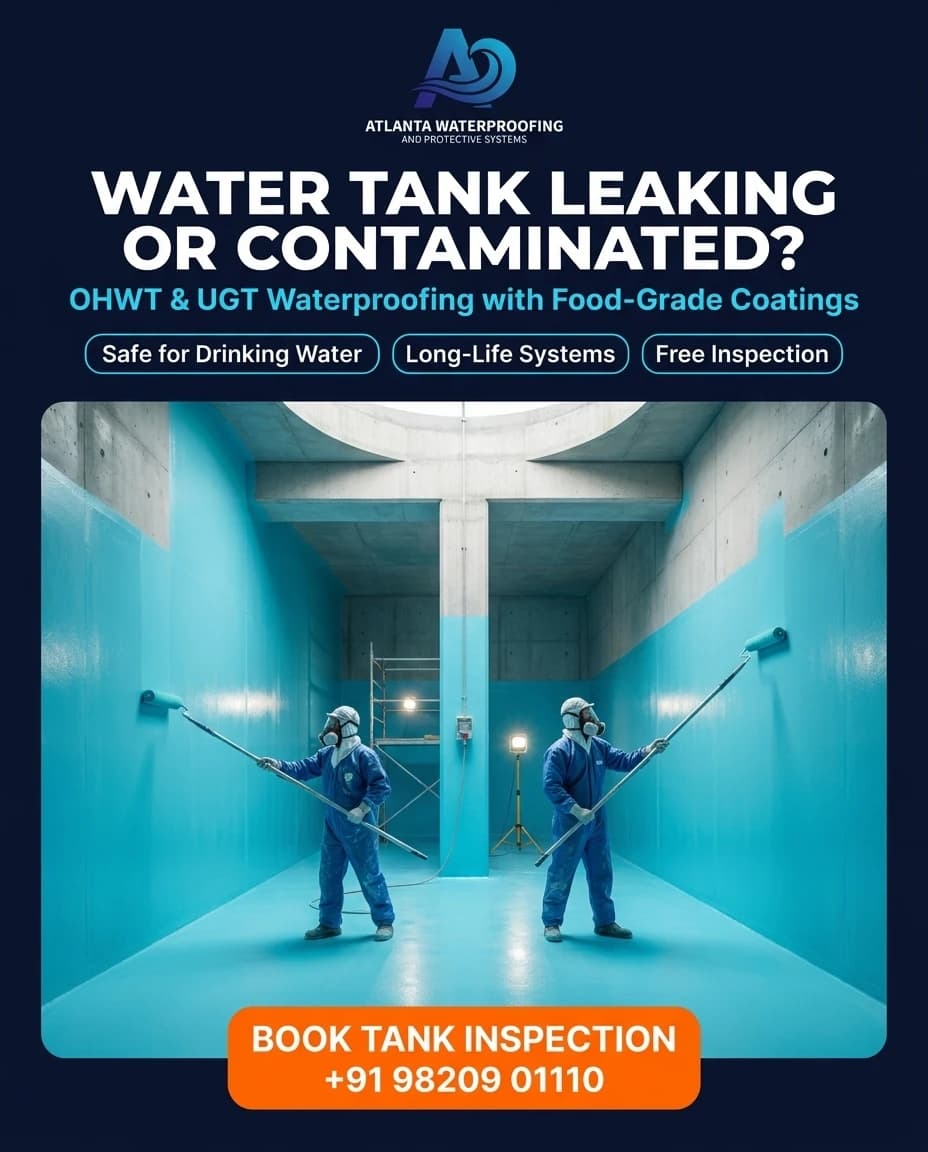
Tap a poster to WhatsApp us, or call +91 98209 01110.
Overhead Water Tank (OHWT) Waterproofing and related work, from our Instagram
@atlantawaterproof ↗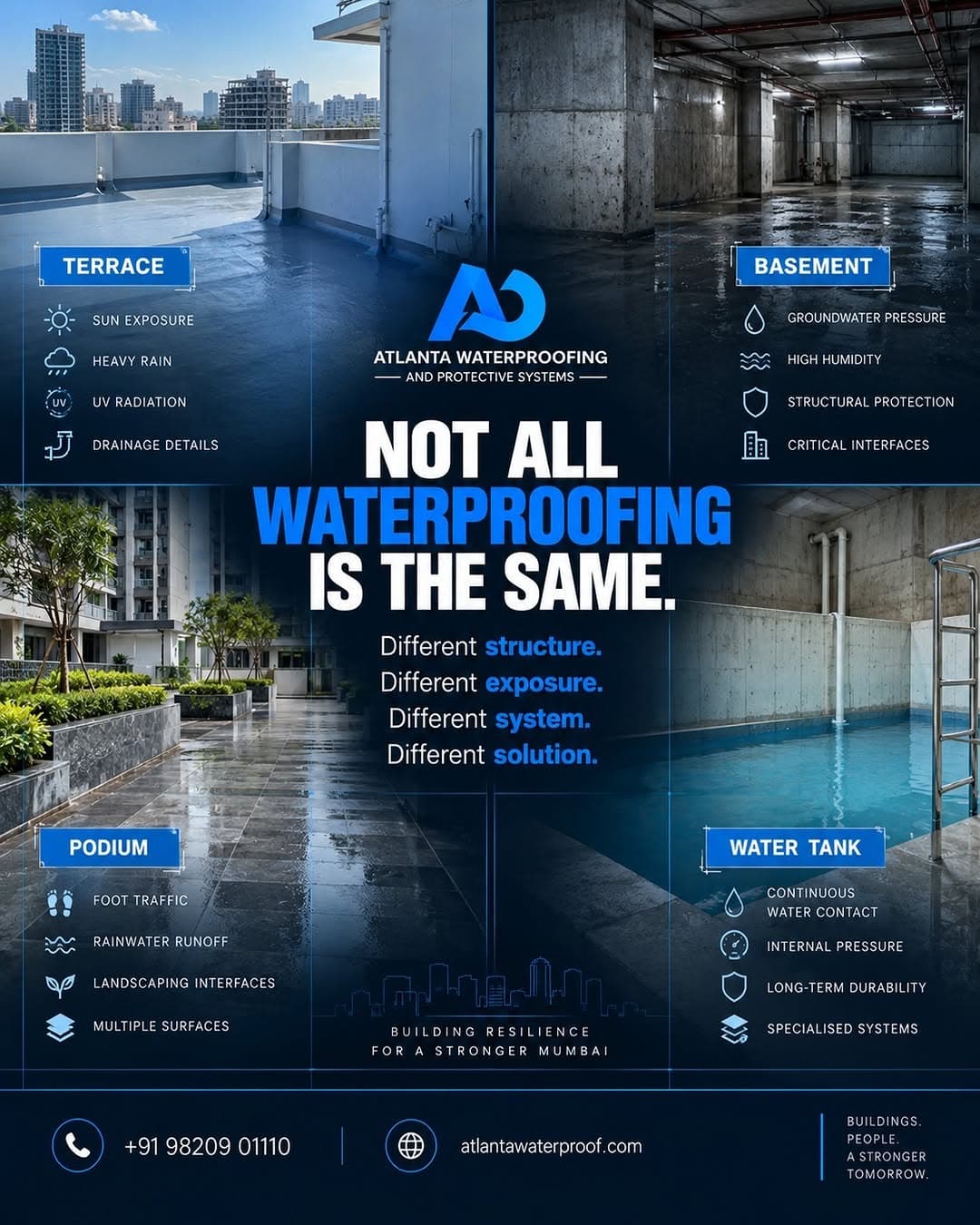
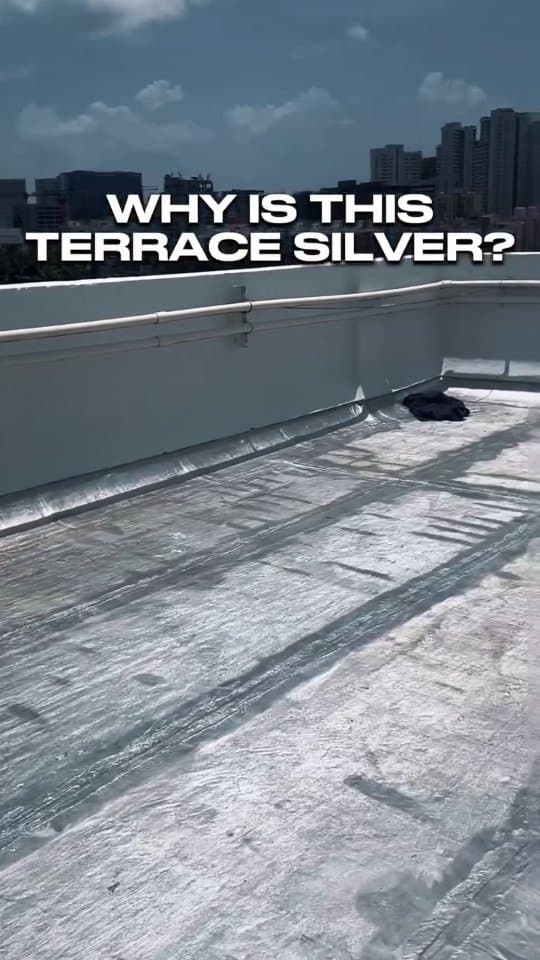
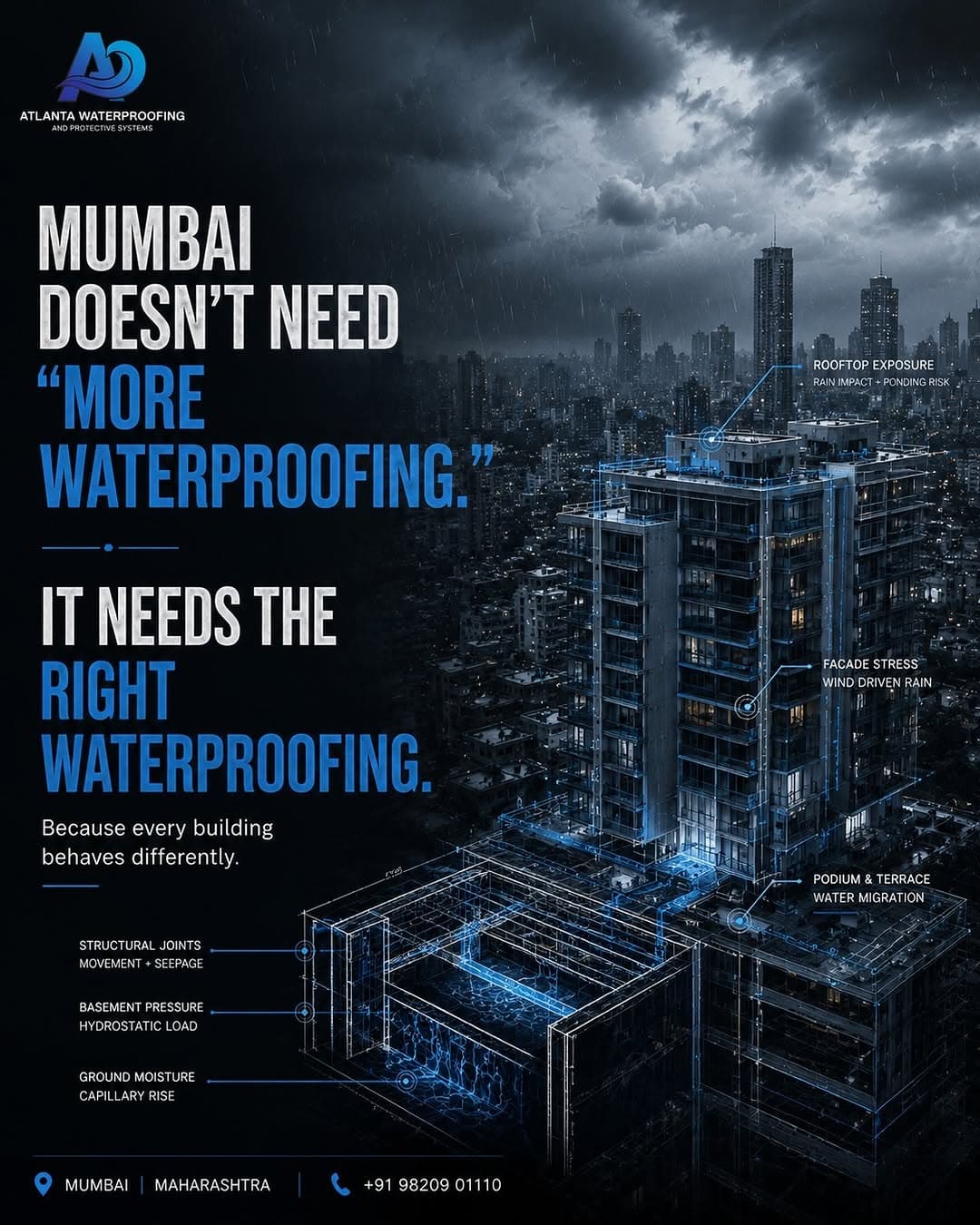

Overhead Water Tank (OHWT) Waterproofing — questions we get asked
When is overhead water tank (ohwt) waterproofing the wrong choice?
A non-potable-rated coating is being considered for a drinking-water tank — this is a health issue, not a preference The leak is from the outlet plumbing rather than the tank shell Selecting a system that does not match the substrate, the exposure and the movement it will see is the most expensive mistake in waterproofing, because the failure only shows up after everything above it has been built.
Why does overhead water tank (ohwt) waterproofing fail when it is done badly?
In our experience the recurring causes are: non-potable coating used on a drinking-water tank; wall-to-base junction not filleted, the most common tank crack location; tank returned to service before the lining fully cured. None of these are material defects — they are execution defects, which is why the same product can last for years on one building and fail in a single monsoon on another.
How do I know the work was done properly?
Ask for evidence against these checkpoints: potable-water certification documented for the product used; fill test held before handover; cure period and flushing logged. A contractor who cannot produce them is asking you to take execution quality on trust, on work that will be buried under a finish and impossible to inspect afterwards.
How long does overhead water tank (ohwt) waterproofing last?
Lining life depends on cleaning regime and water chemistry. Recoating intervals are system-specific. We would rather set that expectation honestly than quote a headline number, because the substrate condition and the standard of application matter more to the outcome than the product's own datasheet figure.
What does overhead water tank (ohwt) waterproofing cost in Mumbai?
Cost depends on area, substrate condition, access, and how much preparation or structural repair is needed before the system can go on. We do not publish a rate per square foot, because a number quoted without seeing the building is either meaningless or misleading. The site inspection is free and produces an itemised scope you can compare against any other quotation.
Which standards apply to overhead water tank (ohwt) waterproofing?
The relevant Indian Standards for this work are IS 3067. These cover the design, preparatory work and material requirements. Where a project specification names a different or additional standard, we work to the specification.
Book the inspection. It costs nothing and it settles the argument.
An engineer visits, finds the actual source, and tells you what the building needs and why. You get a clear scope before any money is discussed.
Mon–Fri 08:00–18:00 · Sat 09:00–16:00 · Jogeshwari West