
Carbon Wrapping (RCC Strengthening) in Mumbai
Carbon wrapping bonds carbon-fibre-reinforced polymer fabric to columns, beams or slabs with structural epoxy, adding tensile and confinement capacity without adding meaningful weight or section. It is used where a member must carry more load than it was built for, or has lost capacity to corrosion, and where enlarging the section is not practical.
When this is the right system — and when it is not
Waterproofing is a selection problem before it is an application problem. Most failures we are called to fix were the wrong system for the substrate, not a bad product.
When this is the right choice
- Members with section loss from corrosion
- Change of use increasing design loads
- Seismic retrofit and column confinement
- Where headroom or space rules out section enlargement
When it is not
- Corrosion is still active beneath — wrapping over live corrosion traps and hides it
- The design has not been done by a qualified structural engineer; this is engineered strengthening, not a coating
The system, layer by layer
Every layer has a job. The ones people cut to save money are usually the ones holding the rest together.
- L01Structural design
By a qualified engineer. Non-negotiable.
- L02Substrate repair
All corrosion arrested and section rebuilt first.
- L03Surface preparation
Ground flat, corners radiused to prevent fibre fracture.
- L04Epoxy primer and saturant
Applied to spec.
- L05CFRP fabric
Laid in the designed orientation and lap.
- L06Protective finish
UV and fire protection as specified.
Almost every failure starts here
Preparation produces nothing visible, costs real money, and is the first thing removed from a cheap quotation. It is also what decides whether the system lasts.
All corrosion must be arrested and the section rebuilt before wrapping — this is not optional and not a matter of judgement. The surface is then ground flat and true, since a wrap bridges high spots and leaves voids beneath. External corners are radiused to a minimum of around 25 mm, because carbon fibre fractures over a sharp arris. Substrate moisture is measured against the epoxy's limit.
How we apply carbon wrapping (rcc strengthening)
Step by step, with the specifications each stage is held to.
- 01
Work to a structural engineer's design
Fabric type, orientation, number of layers and lap length are engineering outputs, not site decisions. Carbon wrapping is designed strengthening, and we execute a design rather than produce one.
- 02
Complete all concrete repair first
Corrosion arrested, section rebuilt, cause of the water ingress resolved. Wrapping over active corrosion seals it in, hides it from inspection, and lets it continue expanding beneath a layer nobody can see through.
- 03
Grind flat and radius the corners
Surface ground true, corners radiused to at least about 25 mm. A sharp corner concentrates stress and fractures the fibre at exactly the point the wrap is meant to be doing its work.
- 04
Prime
Epoxy primer applied to the prepared, dry surface at the stated coverage rate.
- 05
Apply saturant and lay the fabric in the designed orientation
Fabric laid with fibres running in the direction the design requires — confinement wraps run circumferentially, flexural strengthening runs longitudinally. Fibre laid in the wrong orientation contributes almost nothing.
- 06
Consolidate with a roller
Rolled through to expel air and fully wet out the fibres. Air voids in the laminate are weak points and are invisible once the finish coat is on.
- 07
Lap to the designed length
Laps made to the design length, typically 100–150 mm, since the lap is where load transfers between fabric lengths.
- 08
Apply protection and test adhesion
UV and fire protection per the specification, then pull-off adhesion testing to confirm the bond to the substrate.
What goes into the system
- CFRP fabric
- Carbon fibre fabric of the type, weight and orientation specified by the structural engineer.
- Epoxy primer and saturant
- From the same system as the fabric — the resin is what transfers load into the fibre.
- Protective finish
- UV-protective and, where required, fire-protective coating over the cured laminate.
What goes wrong, and what we check
These are the failure modes we are called in to fix on other people's work. The checkpoints on the right are how we avoid repeating them.
Common failure modes
- Wrapping applied over unrepaired corroding reinforcement
- Sharp corners fracturing the fibre
- Fibre orientation not matching the designed load direction
- Debonding from an inadequately prepared substrate
Our QC checkpoints
- Engineer's design and drawings on file
- Corner radii measured
- Pull-off adhesion testing
- Fibre orientation verified against drawing
Systems often specified alongside this one
- Column & Beam RCC Work
Column and beam RCC work is structural concrete repair to a building's primary frame — cutting out distressed concrete, treating or replacing corroded reinforcement, and rebuilding the section with polymer-modified repair mortar or micro-concrete.
- Building Restoration
Building restoration is the structural rehabilitation of an ageing or distressed building — diagnosing why the concrete is failing, repairing it properly, and protecting it so it does not fail again.
- External Plaster & Painting
External plaster and painting is the building's first line of defence against driving rain.
- External Plaster Work
External plaster work removes debonded render and applies new waterproofing-compound-modified cement plaster to the building envelope.
- External Painting
External painting is the final protective and decorative layer on a building envelope.
- ACP Sheet Work
ACP (aluminium composite panel) sheet work installs a rainscreen cladding of aluminium-faced composite panels on a framed subgrid.
Carbon Wrapping (RCC Strengthening) across Mumbai
The right specification changes with the locality — coastal chloride exposure, water table, and the age of the building stock all move the answer.
- Carbon Wrapping (RCC Strengthening) in Colaba
Ward A · 60 min from our office
- Carbon Wrapping (RCC Strengthening) in Fort
Ward A · 55 min from our office
- Carbon Wrapping (RCC Strengthening) in Grant Road
Ward D · 50 min from our office
- Carbon Wrapping (RCC Strengthening) in Worli
Ward G/South · 45 min from our office
- Carbon Wrapping (RCC Strengthening) in Dadar
Ward G/North · 40 min from our office
- Carbon Wrapping (RCC Strengthening) in Khar
Ward H/West · 22 min from our office
- Carbon Wrapping (RCC Strengthening) in Versova
Ward K/West · 18 min from our office
- Carbon Wrapping (RCC Strengthening) in Churchgate
Ward A · 55 min from our office
- Carbon Wrapping (RCC Strengthening) in Marine Lines
Ward C · 55 min from our office
- Carbon Wrapping (RCC Strengthening) in Girgaon
Ward C · 55 min from our office
- Carbon Wrapping (RCC Strengthening) in Tardeo
Ward D · 50 min from our office
- Carbon Wrapping (RCC Strengthening) in Malabar Hill
Ward D · 55 min from our office
Carbon Wrapping (RCC Strengthening) and related work, from our Instagram
@atlantawaterproof ↗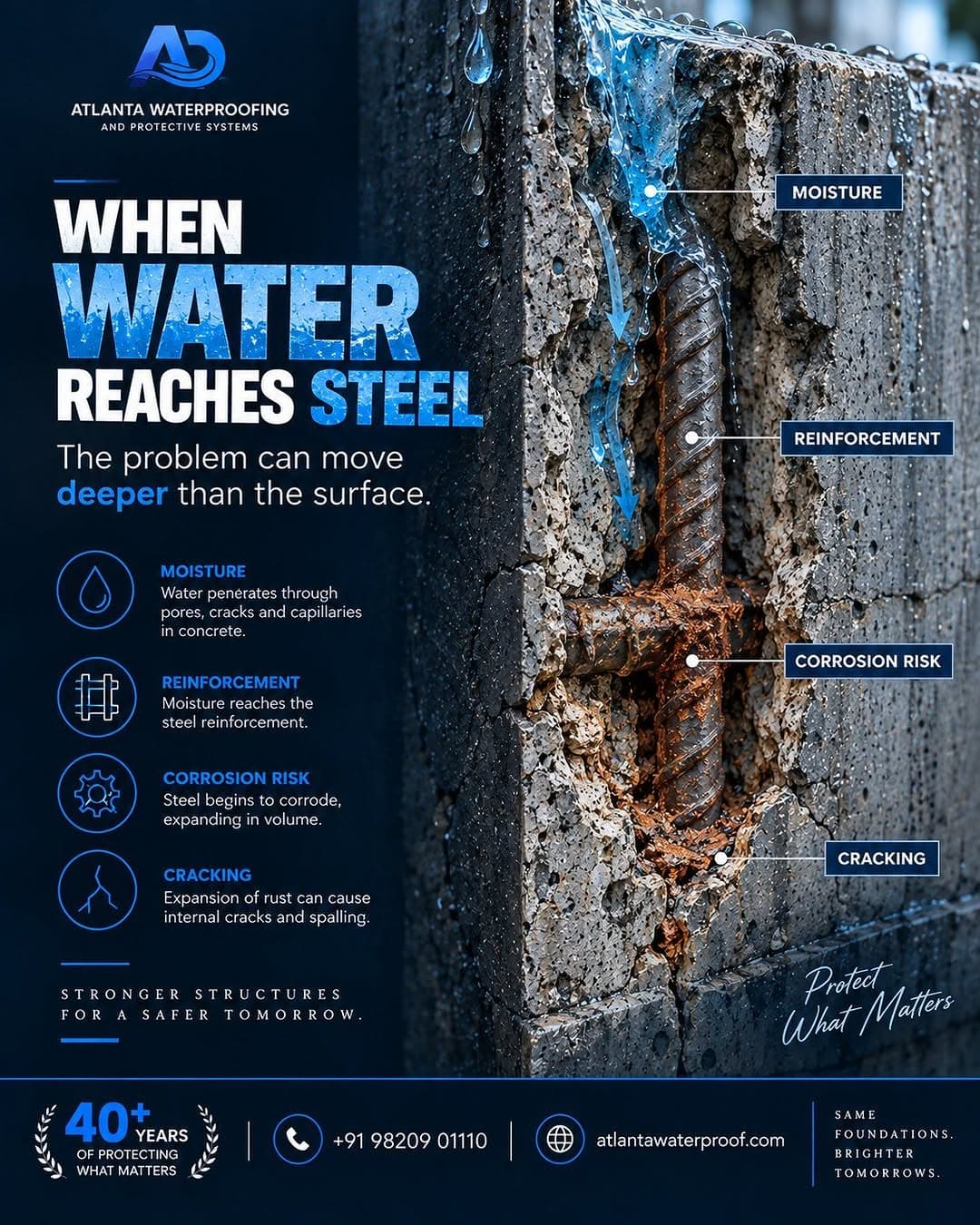
Carbon Wrapping (RCC Strengthening) — questions we get asked
When is carbon wrapping (rcc strengthening) the wrong choice?
Corrosion is still active beneath — wrapping over live corrosion traps and hides it The design has not been done by a qualified structural engineer; this is engineered strengthening, not a coating Selecting a system that does not match the substrate, the exposure and the movement it will see is the most expensive mistake in waterproofing, because the failure only shows up after everything above it has been built.
Why does carbon wrapping (rcc strengthening) fail when it is done badly?
In our experience the recurring causes are: wrapping applied over unrepaired corroding reinforcement; sharp corners fracturing the fibre; fibre orientation not matching the designed load direction; debonding from an inadequately prepared substrate. None of these are material defects — they are execution defects, which is why the same product can last for years on one building and fail in a single monsoon on another.
How do I know the work was done properly?
Ask for evidence against these checkpoints: engineer's design and drawings on file; corner radii measured; pull-off adhesion testing; fibre orientation verified against drawing. A contractor who cannot produce them is asking you to take execution quality on trust, on work that will be buried under a finish and impossible to inspect afterwards.
How long does carbon wrapping (rcc strengthening) last?
Long-lived when bonded to sound, repaired, dry concrete. We would rather set that expectation honestly than quote a headline number, because the substrate condition and the standard of application matter more to the outcome than the product's own datasheet figure.
What does carbon wrapping (rcc strengthening) cost in Mumbai?
Cost depends on area, substrate condition, access, and how much preparation or structural repair is needed before the system can go on. We do not publish a rate per square foot, because a number quoted without seeing the building is either meaningless or misleading. The site inspection is free and produces an itemised scope you can compare against any other quotation.
Which standards apply to carbon wrapping (rcc strengthening)?
The relevant Indian Standards for this work are IS 456, IS 13935. These cover the design, preparatory work and material requirements. Where a project specification names a different or additional standard, we work to the specification.
Book the inspection. It costs nothing and it settles the argument.
An engineer visits, finds the actual source, and tells you what the building needs and why. You get a clear scope before any money is discussed.
Mon–Fri 08:00–18:00 · Sat 09:00–16:00 · Jogeshwari West