
APP Membrane Waterproofing in Bandra West
APP Membrane Waterproofing in Bandra West means treating the specific way buildings fail in H/West Ward: sea-face chloride and salt-laden wind and sloping tile roof failure on old bungalows. With around 2,500 mm of annual rainfall and sea-facing high-rise dominating here, the specification follows the exposure rather than a standard template. We are about 25 minutes away.
Why buildings in Bandra West need this
A roof in Bandra West takes roughly 2,500 mm of rain a year, most of it in about four months. That is not a drizzle load — it is a concentrated hydraulic load on a surface whose falls, outlets and upturns were often never checked after the building was finished.
Bandra West is sea-facing, so the terrace also takes salt-laden air and unobstructed UV. Both shorten the life of an exposed membrane, and both argue for a protected system rather than a bare one.
The failure patterns we see repeatedly in Bandra West are sea-face chloride and salt-laden wind, sloping tile roof failure on old bungalows, terrace leakage in ageing societies. Any specification for this locality has to answer those specifically, not generically.
For app membrane waterproofing specifically, the defects that cause callbacks are under-torched laps that never fully fused; membrane left exposed without mineral or screed protection; blistering from a damp or unprimed substrate. In Bandra West's conditions those are not cosmetic shortcuts — chloride reaches the reinforcement through exactly those gaps.
The stock itself is not uniform here. Bandra West runs to sea-facing high-rise, Bandra bungalows and villas, 1960s-80s societies, heritage Portuguese-era cottages, spanning roughly 15-100 years. A specification that suits one of those does not automatically suit the next, which is why the survey looks at the actual building rather than the postcode.
Unusually mixed: sea-facing towers, ageing societies, and heritage cottages with pitched tile roofs all within a few streets. The pitched-roof stock needs a completely different approach from the flat-slab majority of Mumbai. We work throughout the area, including around Bandra-Worli Sea Link, Bandstand, Carter Road, Mount Mary.
APP Membrane Waterproofing, specified for Bandra West
With 2,500 mm of annual rainfall plus salt and unobstructed UV, an exposed membrane in Bandra West is working at the limit of what it was designed for. We specify a protected build-up — a screed, china mosaic or tile over the barrier — so the layer doing the waterproofing is not also the layer taking the weather.
APP membrane is an atactic-polypropylene-modified bitumen sheet, torch-applied to a primed substrate with lapped and sealed joints. The APP modifier gives it a high softening point and good UV and heat resistance, which suits exposed Indian terraces. It is supplied in rolls, typically 3mm or 4mm thick, in plain or mineral-finished grades.
When this is the right choice here
- Exposed terraces and roofs in high heat and strong sun
- Where a fast, low-dead-load alternative to coba is needed
- Podiums and slabs receiving a protective screed above
When it is not
- Very low-temperature or highly dynamic joints, where SBS flexibility is better suited
- Substrates too damp to prime and torch safely
- Confined or fire-sensitive areas where an open torch flame is unacceptable
Full app membrane waterproofing specification, method and materials →
Sixty seconds, before you call anyone
- Go up to the terrace after rain and look for standing water. Anything still there after 24 hours marks a low point the falls never accounted for.
- Look specifically for evidence of under-torched laps that never fully fused — it is the most common cause of failure in this system.
- Then check for membrane left exposed without mineral or screed protection, which is the next most frequent.
- Separately, look for sea-face chloride and salt-laden wind, which is the pattern this part of Bandra West produces regardless of which system was used.
- Photograph it while it is wet, and note whether it worsens with rain or with usage. Rain-linked points to the building envelope; usage-linked points to plumbing. That single distinction settles most arguments about who is responsible.
- Do not chip into a saturated ceiling or paint over a damp patch. The first risks bringing plaster down on someone; the second destroys the evidence needed to trace the path.
How app membrane waterproofing is carried out in Bandra West
The sequence below is the same wherever the work is done. What changes in Bandra West is where the risk concentrates: given that the recurring local problems are sea-face chloride and salt-laden wind and sloping tile roof failure on old bungalows, the stages worth watching most closely here are probe the seams.
The substrate must be sound, clean and dry — surface moisture below roughly 5% by most manufacturers' requirements. Laitance and curing compound are mechanically removed. Cracks are cut into a V-groove and filled. All internal angles receive a cement fillet so the membrane turns the corner on a curve rather than bridging a sharp angle where it would be unsupported. The prepared surface is primed and the primer allowed to tack off fully before torching begins.
- 01
Confirm the substrate is dry and falls are correct
APP is torch-applied to a dry substrate. Trapped moisture beneath a sealed membrane turns to vapour in Mumbai heat and lifts it into blisters. Falls are corrected before the membrane, not after.
- 02
Prime
Bitumen primer applied at the stated coverage rate across the full area including upturns, then allowed to tack off. Torching onto an unprimed or still-wet primed surface is a direct cause of debonding.
- 03
Set out the rolls
Rolls are laid out dry and aligned before torching, starting from the low point so laps shed water rather than face into it. Side laps at 100 mm and end laps at 150 mm, with end laps staggered between adjacent rolls.
- 04
Torch and bond
The membrane is unrolled under flame with even heat, bonding the full width rather than spot-bonding. A small bead of molten bitumen — roughly 5–10 mm — should be visible bleeding from every seam. That bead is the visual confirmation the lap has actually fused.
- 05
Upturns and terminations
Carried a minimum of 150 mm above finished level at parapets and mechanically terminated at the top with a batten or sealed termination bar, not simply feathered out and left.
- 06
Dress the outlets
Each rainwater outlet receives an additional collar piece taken down into the pipe, bonded to the main sheet.
What we check on site
- Lap widths measured, bitumen bleed visible along every seam
- Probe test on cooled seams
- Ponding test before screed
- Primer coverage verified before torching
Curing
No curing period as such — the bond is formed as the bitumen cools, and the membrane is effectively serviceable once cool. The critical window is instead the torching itself: too little heat and the lap never fuses, too much and the sheet's reinforcement is damaged.
Materials
- Membrane
- APP-modified bitumen sheet at 3 mm or 4 mm, plain or mineral-finished depending on whether it stays exposed. The APP modifier gives a high softening point suited to Indian roof temperatures.
- Primer
- Bitumen primer compatible with the sheet, applied to full coverage.
- Reinforcement
- Additional ply at upturns, outlets and internal angles.
Our nearest documented project, and how far we are
Bandra–Worli Sea Link
Associated with the waterproofing works on the Bandra–Worli Sea Link, one of India's most prestigious infrastructure landmarks.
Read the project record →~25 min
Our office is in Jogeshwari West, about 9 km from Bandra West — normally around 25 minutes outside peak traffic.
Travel time is a typical off-peak estimate for Bandra West, not a guaranteed response time. Mumbai traffic being what it is, we confirm an arrival window when you call.
What app membrane waterproofing costs in Bandra West
Rate per square foot: To be confirmed
We have deliberately not published a rate here. Cost on a Bandra West building depends on the area, the condition of the existing structure, access and scaffolding, and how much preparation or structural repair is needed before the system can go on — and those vary far more between two buildings on the same street than they do between localities. The site inspection is free and produces an itemised scope you can compare line by line against any other quotation.
APP Membrane Waterproofing in Bandra West — questions we get asked
How quickly can you reach Bandra West?
Our office is in Jogeshwari West, about 9 km from Bandra West, and we normally allow around 25 minutes in off-peak traffic. We also work regularly in Khar, Bandra East, Santacruz, so a crew is often already in this part of the city.
Why do buildings in Bandra West leak more than elsewhere?
Bandra West records roughly 2,500 mm of rain a year, measured at the IMD Santacruz observatory, suburbs. Combined with sea-facing high-rise and Bandra bungalows and villas in the 15-100 years range, the recurring problems here are sea-face chloride and salt-laden wind and sloping tile roof failure on old bungalows. It is less that Bandra West leaks more, and more that it leaks in a particular and fairly predictable way.
Which BMC ward is Bandra West in, and does that matter?
Bandra West falls under H/West Ward (H/West), covering pincodes 400050. It matters practically rather than technically: ward boundaries govern which office handles permissions, notices and any municipal correspondence a society may need during major repair work.
Does being close to the sea change what Bandra West needs?
Substantially. Chloride from coastal air penetrates render and cover concrete and drives reinforcement corrosion far faster than inland. Two things follow: repair specifications must remove chloride-contaminated concrete rather than patch over it, and protective coatings should resist water ingress while still allowing the wall to dry outward. Sealing a salt-laden wall with an impermeable coating traps the problem inside.
What does app membrane waterproofing usually involve in Bandra West?
With 2,500 mm of annual rainfall plus salt and unobstructed UV, an exposed membrane in Bandra West is working at the limit of what it was designed for. We specify a protected build-up — a screed, china mosaic or tile over the barrier — so the layer doing the waterproofing is not also the layer taking the weather. The scope is confirmed after a site inspection, because the condition of the existing structure changes both the method and the cost more than the locality does.
Have you worked near Bandra West?
Our nearest documented project is Bandra–Worli Sea Link, roughly 5 km from Bandra West. Associated with the waterproofing works on the Bandra–Worli Sea Link, one of India's most prestigious infrastructure landmarks. We have also worked across Khar, Bandra East, Santacruz and the surrounding Western Suburbs.
We also work across Western Suburbs
- APP Membrane Waterproofing in Khar
1.2 km from Bandra West · H/West Ward
- APP Membrane Waterproofing in Bandra East
2.2 km from Bandra West · H/East Ward
- APP Membrane Waterproofing in Santacruz
2.7 km from Bandra West · H/West and H/East Wards
- APP Membrane Waterproofing in Sion
3.9 km from Bandra West · F/North Ward
- APP Membrane Waterproofing in Vile Parle
4.6 km from Bandra West · K/West and K/East Wards
- APP Membrane Waterproofing in Prabhadevi
4.7 km from Bandra West · G/South Ward
Other work we do in Bandra West
- Terrace Waterproofing in Bandra West
Terrace waterproofing is the application of a continuous water barrier across a roof slab, laid to a fall so rainwater drains rather than ponds.
- Brick Bat Coba Waterproofing in Bandra West
Brick bat coba is the traditional Indian terrace system: broken brick pieces bedded in waterproofed cement mortar, laid to a fall and finished with china mosaic or IPS.
- China Mosaic Waterproofing in Bandra West
China mosaic is a finish of broken glazed ceramic tile pieces set in waterproofed cement mortar over a terrace.
- SBS Membrane Waterproofing in Bandra West
SBS membrane is a styrene-butadiene-styrene-modified bitumen sheet.
Our recent work in Bandra West, on Instagram
@atlantawaterproof ↗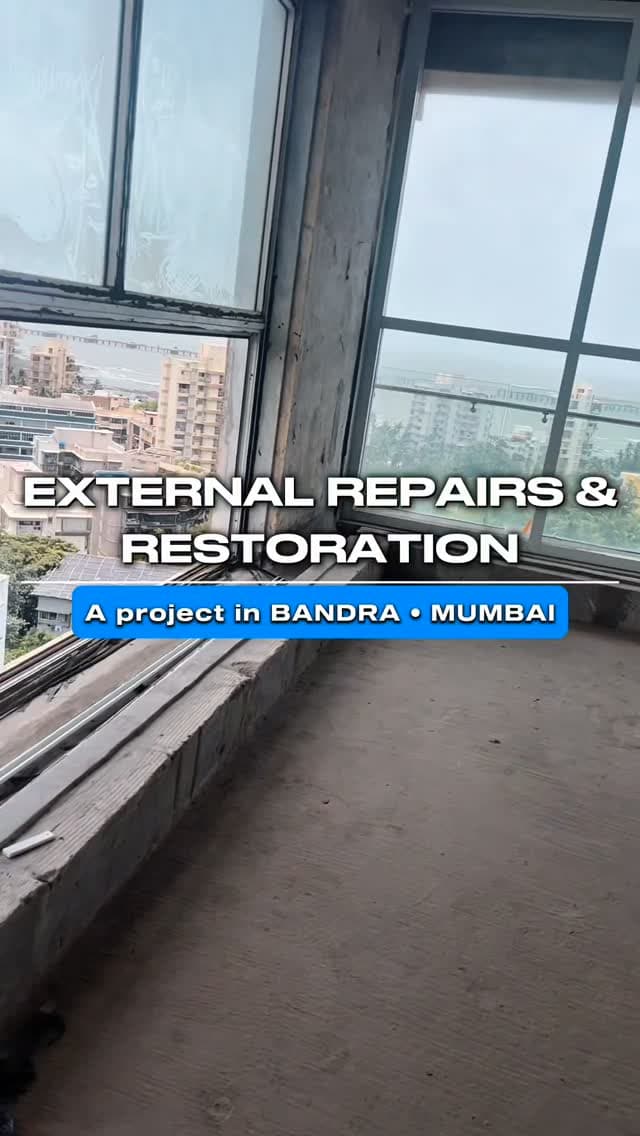 Reel
ReelExternal repairs at height, Bandra
Book a free inspection in Bandra West
An engineer visits, traces the actual source, and gives you a written scope. Our office is in Jogeshwari West, about 9 km from Bandra West — normally around 25 minutes outside peak traffic.
Mon–Fri 08:00–18:00 · Sat 09:00–16:00 · Jogeshwari West